
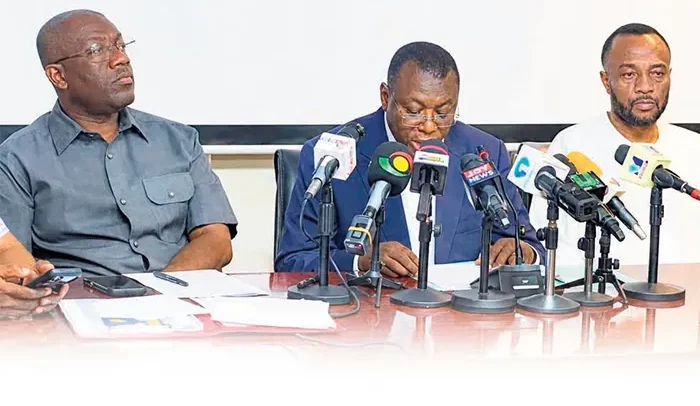
Mohammed Amin Adam flanked by Kojo Oppong Nkrumah (L) and Jerry Ahmed Shaib
The New Patriotic Party (NPP) Minority in Parliament has questioned the sharp increase in the nation’s public debt and accused the government of failing to account for jobs created under its flagship 24-Hour Economy programme, ahead of the presentation of the 2027 Budget Statement and Economic Policy.
Addressing a press conference in Parliament yesterday, former Finance Minister and NPP spokesperson on Finance, Dr. Mohammed Amin Adam, said the government’s fiscal management and employment promises raised serious questions about transparency and implementation.
Debt Up GH¢92.8bn In Seven Months
According to the caucus, public debt increased from GH¢641.1 billion in December 2025 to GH¢733.9 billion in July 2026, with domestic debt accounting for GH¢62.9 billion of the increase.
The party is demanding an explanation from the government over how the additional debt was incurred and the purposes for which the borrowed funds were utilised.
Dr. Amin Adam said the overall cash deficit over the seven-month period was reported at approximately 0.6 percent of Gross Domestic Product (GDP), equivalent to about GH¢10 billion.
He argued that the difference between the increase in public debt and the reported cash deficit required a detailed explanation from the government.
“Government must explain this gap: how much of the new borrowing went into the Sinking Fund and cash buffers, how much into arrears, and how much has simply not been accounted for,” the NPP caucus stated.
The Minority said domestic debt increased from GH¢333.8 billion to GH¢396.7 billion between December 2025 and July 2026, representing an increase of GH¢62.9 billion.
It also indicated that the country’s debt-to-GDP ratio had increased from 41.5 percent to 45.9 percent during the period.
The opposition party said the figures raised concerns about the government’s borrowing strategy, particularly at a time when it was presenting its economic management as a success.
It challenged the Finance Minister, Dr. Cassiel Ato Forson, to provide a comprehensive reconciliation of the debt figures when he presents the 2027 Budget to Parliament on Thursday, November 12.
The party wants the government to disclose how much of the additional borrowing was used to support the Sinking Fund and cash reserves, how much went into settling outstanding obligations and whether any portion remained unaccounted for.
Capital Expenditure Shortfalls
The Minority also questioned the execution of capital expenditure, arguing that the government had consistently failed to release and spend the amounts approved in the national budget.
It cited figures showing that capital expenditure for January to September 2025 stood at GH¢10.9 billion against a budget target of GH¢26.6 billion, representing a shortfall of 59 percent.
For the first half of 2026, total expenditure was GH¢127.2 billion against a budgeted GH¢158.6 billion.
The caucus argued that the government must demonstrate how borrowed funds and approved expenditure have translated into completed projects, economic opportunities and improved living conditions.
It wants the 2027 Budget to include a full reconciliation of the increase in domestic debt, alongside a disclosure of outstanding arrears and other financial commitments.
24-Hour Economy Jobs Unaccounted For
The Minority also accused the government of failing to account for jobs created under the 24-Hour Economy programme, questioning the credibility of the administration’s employment promises.
The party says that more than a year after the programme was launched, the 24-Hour Economy Secretariat is still unable to provide figures on the number of jobs generated, despite the government’s target of creating at least 1.7 million jobs by 2028.
Dr. Amin Adam said the government announced on June 30, 2025 that it would mobilise US$4 billion over four years to support the 24-Hour Economy.
President John Dramani Mahama subsequently launched the programme on July 2, 2025, while the 2026 Budget indicated that it had entered full implementation.
However, the NPP Members of Parliament (MPs) said an October 19, 2026 public admission by the Head of Strategy at the 24-Hour Economy Secretariat revealed that the Secretariat could not state how many jobs had been created under the initiative.
According to the opposition, the Secretariat was only working with the Ghana Statistical Service to establish a system for measuring employment generated by the programme.
The Minority described the situation as a worrying gap between the government’s employment promises and its ability to demonstrate results.
It argued that the government had promised jobs before establishing an effective mechanism to measure and verify them.
The caucus also questioned the status of the US$4 billion expected to finance the programme, saying Ghanaians had not been informed how much of the proposed funding had actually been mobilised.
It further referred to US$5.5 billion in project agreements announced in July 2026, arguing that signed agreements should not be confused with actual disbursements, completed projects or jobs created.
The Minority said that even if all 160,000 projected jobs associated with four projects materialised, the figure would represent less than one-tenth of the 1.7 million jobs promised under the programme.
The caucus also pointed to inconsistencies in the 2026 Budget, which it said cited GH¢110 million for the 24-Hour Economy in the budget speech, while the expenditure table showed GH¢90 million.
Youth Unemployment Concerns
Beyond the programme, the NPP MPs raised concerns about the country’s wider unemployment situation, citing Ghana Statistical Service figures showing that youth unemployment among people aged 15 to 35 averaged 21.9 percent during the first three quarters of 2025.
It said unemployment among young people aged 15 to 24 averaged 32.5 percent, while the rate in Greater Accra reached 31.9 percent.
The caucus argued that a programme designed to address unemployment must be supported by verifiable employment records showing the number of people engaged, their locations and whether the jobs are permanent or temporary.
It is therefore demanding a published financing and implementation report for the 24-Hour Economy, independently verifiable job figures and a public dashboard supported by an independent audit.
The Minority also wants the government to reconcile the conflicting budget allocations and disclose the full financing structure of the programme.
It said the 2027 Budget must provide evidence of actual implementation rather than rely on announcements, projections and agreements.
The NPP MPs said Ghanaians deserved a transparent account of the country’s finances rather than assurances based on headline economic indicators.
By Ernest Kofi Adu, Parliament House