
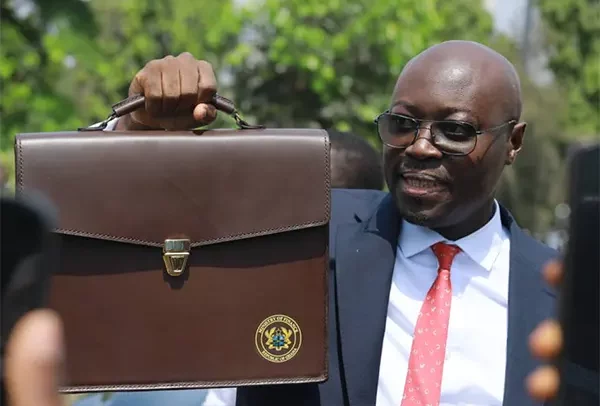
Dr. Cassiel Ato Forson
The Minister of Finance, Dr. Cassiel Ato Forson, has announced plans by the government to invest the equivalent of US$10 billion over four years, beginning in 2027, in a new economic transformation programme aimed at expanding domestic production, creating jobs and strengthening Ghana’s industrial capacity.
Presenting the 2027 Budget Statement and Economic Policy to Parliament yesterday, the Minister said the programme, dubbed the New Economy, would run from 2027 to 2030.
He said the initiative was designed to address longstanding structural weaknesses in the economy, particularly the country’s dependence on raw material exports, limited domestic value addition and inadequate creation of productive employment.
According to him, Ghana’s 70th independence anniversary in 2027 presents an opportunity to change the direction of the economy and build a productive base capable of sustaining long-term growth.
Dr. Forson said the programme would be implemented through eight interconnected pillars: macroeconomic stability and affordable finance, commercial agriculture, energy infrastructure, critical minerals value addition, tourism, culture and creative arts, textiles and garments, pharmaceuticals and manufacturing, including biomanufacturing, and the technology economy.
He explained that the pillars would operate as an integrated productive system, with affordable financing supporting farmers and manufacturers, agriculture supplying industrial raw materials, and reliable energy underpinning production and the 24-hour economy.
The Minister indicated that tourism, culture and creative arts would also be developed into sources of employment and foreign exchange, while investments in pharmaceuticals and biomanufacturing would increase local production of medicines and vaccines.
He said the private sector would carry the principal responsibility for investment, innovation, production and sustainable employment, while the government would provide strategic infrastructure, prepare bankable projects and establish predictable conditions for businesses.
He stated that the government support would be transparent, time-bound and linked to verifiable results.
On the financing of the programme, Dr. Forson said the government would create fiscal space by reducing the primary surplus target from 1.5 percent to 0.5 percent of Gross Domestic Product (GDP) over the period.
He added that tax reforms already approved by Parliament and compliance measures being implemented by the Ghana Revenue Authority were expected to generate an additional 0.5 percent of GDP.
For 2027, the government plans to invest GH¢30 billion, representing 1.5 percent of GDP, in the programme, he disclosed.
The Minister said the projects would undergo rigorous appraisal and value-for-money assessments, adding that public funds would be concentrated on strategic assets and public goods.
As part of efforts to sustain macroeconomic stability, he said the government would maintain a positive primary surplus of at least 0.5 percent of GDP from 2027, keep public debt consistent with 45 percent of GDP and preserve single-digit inflation.
By 2030, the Minister revealed that the government is targeting real GDP growth of approximately eight percent and unemployment below 8 percent, alongside a credible pathway towards an investment-grade sovereign credit rating.
Dr. Forson said the government would also publish an annual investment-grade readiness report covering fiscal performance, debt affordability, reserve accumulation, monetary credibility, financial sector strength, institutional quality and economic diversification.
He further announced plans to bring the cost of capital into single digits to improve access to affordable financing for businesses.
Development Bank Ghana, Ghana EXIM Bank and participating financial institutions would be used to expand financing for productive enterprises through credit guarantees, equipment leasing, export finance and long-term funding.
On agriculture, the Minister said US$3 billion of the total US$10 billion programme would be invested in commercial agriculture to reduce food imports, strengthen food security and create jobs.
The intervention would focus on rice, sugar, poultry, maize, soya, animal feed, aquaculture, oil palm, vegetables and cocoa value addition.
He said the programme would establish integrated agricultural value chains connecting farmers to irrigation, improved seeds, mechanisation, storage facilities, processing plants, transportation and markets.
The rice intervention, he said, would bring an additional 100,000 hectares under cultivation, with targeted yields of five to six metric tonnes per hectare and the potential to create about 125,000 jobs.
According to him, the government also intends to prohibit commercial rice imports by the end of 2030, while import licences from 2027 would be tied to purchases from verified Ghanaian farmers and millers.
Dr. Forson said the government would amend public procurement laws to require schools, hospitals and other public institutions to purchase locally grown rice and other Ghanaian staples.
He also announced plans to achieve sugar self-sufficiency by 2030 through irrigated production zones, commercial estates, organised outgrowers and processing mills.
In the poultry sector, the government would develop an integrated value chain covering breeder farms, hatcheries, feed production, processing plants, cold storage and distribution.
The programme would also address the country’s estimated annual fish supply gap of 500,000 metric tonnes through investments in aquaculture, fish farms, hatcheries, feed, cold-chain facilities and modern fish landing sites.
For oil palm, the Minister noted that the government plans to develop 100,000 hectares across the Western, Central, Eastern, Volta and Ashanti regions.
According to him, the initiative, which is expected to create 250,000 jobs, will be supported by a proposed US$500 million financing window with long repayment periods and a five-year moratorium.
Dr. Forson said suitable land had been identified and the Ministry of Lands and Natural Resources was undertaking acquisition processes in line with international best practices.
He added that the US$500 million financing arrangement with the World Bank had been agreed upon and would be presented to Parliament.
The Minister said the ultimate measure of the New Economy Programme would be the number of jobs created, improvements in living standards and the development of communities.
He urged Ghanaians to support the transformation agenda, saying the economic recovery must be used to build productive capacity rather than repeat past cycles of debt-financed consumption and economic instability.
By Ernest Kofi Adu, Parliament House