
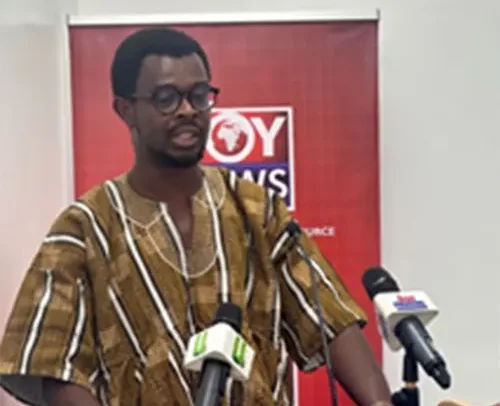
Prof. Yegandi Imhotep Paul Alagidede
Activating about 50 percent of the country’s gold reserves could generate enough domestic resources to finance up to four years of national expenditure without support from external bodies, Chairman of the Bank of Ghana’sResearch Consortium at the University of Ghana Business School, Prof. Yegandi Imhotep Paul Alagidede, has said.
He made the assertion at a public lecture organised by the Centre for Policy Scrutiny (CPS) in Accra yesterday, where he described Ghana not as a poor country, but as a rich nation constrained by how it measures and understands its own wealth.
According to him, the country’s 2024 Budget could have been fully funded through domestic resources if the country had activated a portion of the equity embedded in its natural resources, particularly gold.
“By activating about 50 percent of our in-situ equity, which is right under our feet, it is enough to fund about four years of national expenditure without borrowing a single pesewa from outside the country,” he stated.
Prof. Alagidede explained that the nation’s economic challenges are less about a lack of resources and more about the frameworks used to measure national income and development.
He argued that orthodox economic models only assign value to resources once they are extracted and sold, thereby ignoring the wealth embedded in unexploited natural assets.
“If you have resources like gold or cocoa, it is only when those resources are extracted and sold in the market that the orthodox system values them, but that is a very narrow way of looking at development,” he said.
He noted that while economists often emphasise factors such as institutional development, colonialism and resource extraction in explaining growth, these approaches still postpone the value of present assets into the future.
Drawing on examples from African indigenous societies, Prof. Alagidede said traditional systems of wealth measurement were more holistic, accounting for social capital, livestock, communal relationships and unpaid labour, rather than focusing solely on cash transactions.
He also criticised the current United Nations System of National Accounts for ignoring unpaid care work, the informal economy and indigenous knowledge systems.
“When I was growing up in my village in the north, total income included cattle, poultry, social relationships and the contributions of women and men. What was visible and invisible was all part of national income. About 80 percent of employment in many African economies comes from the informal sector, yet most of this is completely ignored in our national accounting,” he said.
The economist further proposed using gold as an anchor for the national currency instead of selling it for dollars, noting that the Gold Board has already mobilised significant value from small-scale mining.
However, he cautioned that environmental costs, particularly from artisanal and small-scale mining, must be factored into any such strategy.
He called for a comprehensive sovereign asset audit, reforms in national income accounting, and a shift by the Bank of Ghana and the Ministry of Finance towards balance-sheet-based economic management.
“Ghana is a wealthy nation in a temporary state of amnesia. In the midst of an abundance of gold, we are liquidity-trapped. We borrow paper from abroad while sitting on a bedrock of wealth at home,” Prof. Alagidede added.
By Ebenezer K. Amponsah