
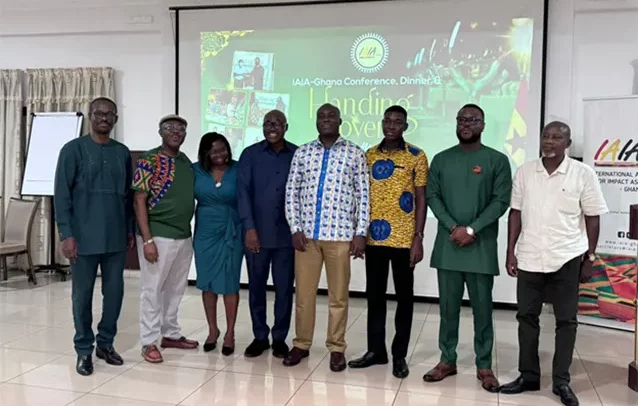
IAIA-Ghana New Executives
The newly sworn-in President of International Association for Impact Assessment-Ghana (IAIA Ghana-Affiliate), Joseph Yeboah, has made professional certification and registration for environmental and social practitioners a top priority, citing the need to restore credibility and public trust in environmental practice.
Speaking at the IAIA Ghana Conference, Mr. Yeboah emphasised that Ghana’s environmental assessment professionals must assert their relevance in national development.
“Our tenure begins at a critical intersection. Ghana today demands higher professionalism from environmental and social practitioners, even as we confront growing challenges in environmental management and governance,” he noted.
The new leadership team, which includes Kojo A. Amoyaw-Osei as Vice President, Nana Kesewa Akese as Secretary, and Kwakye Kwabena Mamphey as Treasurer, is set to focus on enhancing IAIA Ghana’s visibility, strengthening professional capacity, and supporting the development of a new accreditation system for environmental professionals.
Supporting the new council is a Board of Directors made up of Mr. Ebenezer Appah-Sampong, the Immediate Past President; Dr. Edith Essie Clarke; Prof. Francis Nunoo; Dr. Frank Anim; Ing. Rita Ohene Sarfoh; and Mr. Kwabena Badu Yeboah.
Mr. Yeboah, who takes over leadership of the Association for the next two years, said professionalising environmental practice would be central to his administration’s agenda, particularly through the development of a clear accreditation and certification system for practitioners.
Mr. Yeboah’s three-point agenda includes boosting the association’s influence in national environmental discussions, improving professional standards through continuous development and peer learning, and collaborating with stakeholders like the Environmental Protection Authority to establish robust standards.
The Immediate Past President, Ebenezer Appah-Sampong, noted progress in IAIA-Ghana’s growth, including increased membership and discussions on a legal framework for certification, but highlighted challenges such as financing and participation.
Mr. Sampong also reported growth in membership, which he said stood at about 250, though he acknowledged challenges relating to active participation, financing and the lack of a permanent secretariat.
BY Prince Fiifi Yorke