
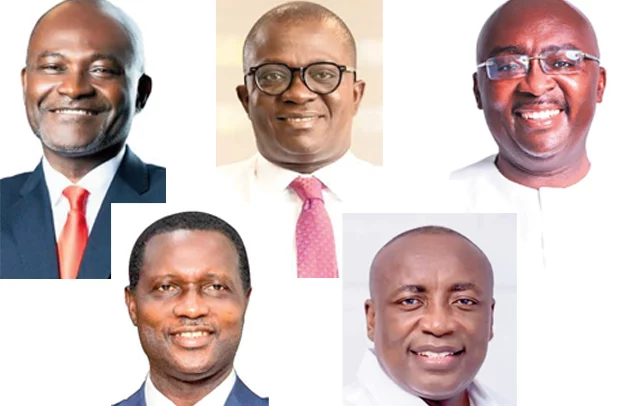
The opposition New Patriotic Party (NPP) today goes to the polls to elect its presidential flagbearer for the 2028 general election, with an estimated 212,000 delegates expected to cast their ballots nationwide in what party leaders and political analysts describe as one of the most consequential internal elections in the party’s history.
Beyond the immediate question of who leads the NPP into the next national contest, today’s vote is widely seen as a referendum on the party’s recent internal reforms, and its readiness to reorganise, reconnect and reposition itself after losing power.
Five candidates are seeking the mandate of delegates. They are former Assin Central Member of Parliament, Kennedy Ohene Agyapong; former Minister for Food and Agriculture, Dr. Bryan Acheampong; former Vice President, Dr. Mahamudu Bawumia; former Minister of Education, Dr. Yaw Osei Adutwum; and former General Secretary of the party, Ing. Kwabena Agyei Agyepong.
Together, they represent a broad spectrum of experience within the NPP, ranging from technocrats and former cabinet ministers to grassroots mobilisers and long-serving party administrators.
Voting Arrangements and Oversight
Voting will take place at 333 polling stations across the 276 constituencies. Polls open at 7:00 a.m. and close at 2:00 p.m., after which counting will be conducted immediately at each polling centre.
Results will then be collated at the regional level and transmitted nationally for the official declaration. The entire process is being supervised by the Electoral Commission, with security provided by the Ghana Police Service.
The Presidential Election Committee said strict procedures are in place to safeguard the credibility of the election.
Delegates must undergo accreditation before voting, proxy voting is prohibited, and all ballots must be cast in person. These measures, according to the party, are intended to ensure transparency, prevent disputes and bolster confidence in the outcome.
Why This Election Matters
Senior party figures say today’s contest goes beyond individual ambition. “Internal elections shape the kind of leadership a party offers the nation, so the Electoral College and the process matter for credibility and unity,” former National Chairman, Freddie Blay, has noted.
His remarks reflect a broader consensus within the party that the legitimacy of the flagbearer will be critical to unifying supporters and appealing to floating voters ahead of the 2028 general election.
This election is also significant because it is the first time the NPP is selecting a flagbearer under its expanded Electoral College system, a reform introduced to broaden participation and reduce the influence of narrow voting blocs.
From a Narrow Base to a Broad College
Previously, the choice of a flagbearer was restricted largely to current party office holders consisting of polling station executives, constituency executives, regional executives and national officers.
While that system produced candidates who went on to win national elections, critics argued that it concentrated power in the hands of a relatively small group, creating incentives for vote buying and internal factionalism.
Under the new system, the Electoral College has been significantly expanded. In addition to current executives, the voting base now includes former Members of Parliament (MPs), former ministers, former party executives, Metropolitan, Municipal and District Chief Executives (MMDCEs), representatives of the party’s external branches, party patrons, elders and TESCON representatives.
Party insiders say the reform is designed to recognise long service, reward loyalty, and ensure that the eventual flagbearer enjoys broader acceptance across different layers of the party.
Supporters of the change argue that a candidate emerging from such a diverse and inclusive electorate is better positioned to unite the party and command authority.
What to Watch Today
As voting gets underway, observers will be watching several key indicators. These include turnout levels across constituencies, the influence of newly added groups within the Electoral College, and whether the process remains peaceful and transparent from start to finish.
Any disruptions, delays or disputes could test the party’s internal dispute-resolution mechanisms and its commitment to democratic norms.
The Minority Leader, Alexander Afenyo-Markin, has urged calm and restraint, stressing that a credible and inclusive internal election will not only strengthen the NPP but also contribute positively to Ghana’s broader democratic culture.
The Candidates and Their Campaigns
Dr. Mahamudu Bawumia: Continuity, Data and Reform
Former Vice President Dr. Mahamudu Bawumia, 62, enters the race as the most recognisable figure among the five contenders. An economist by training and a former Deputy Governor of the Bank of Ghana, he served two terms as Vice President and was a central figure in the Akufo-Addo administration’s economic and governance agenda.
Dr. Bawumia’s political rise began before elective politics. He was first spotted by former President John Agyekum Kufuor during a formal engagement in the United Kingdom, leading to his appointment as Deputy Governor of the Bank of Ghana.
In that role, he was involved in the re-engineering of the national currency and earned a reputation as a meticulous and innovative policymaker.
As Vice President, he carved out an unusually active role for himself, championing digital transformation as a tool for economic efficiency and anti-corruption.
Initiatives such as the digital address system, mobile money interoperability, paperless ports and digitised utility billing have become central pillars of his legacy.
Supporters credit these reforms with improving revenue mobilisation, reducing human discretion and making public services more accessible.
He has also been associated with Agenda 111, the health infrastructure programme aimed at expanding access to healthcare facilities, and Ghana’s drone-based medical delivery system, which has attracted international attention.
More recently, economic interventions such as the Gold for Oil and Domestic Gold Purchase programmes have been cited by Bank of Ghana officials as contributing to relative currency stability and stronger foreign reserves.
However, Dr. Bawumia’s candidacy is not without controversy. Critics argue that his close association with the previous administration’s economic management could pose challenges in a general election, particularly among voters affected by recent economic hardships.
Others question whether his calm, technocratic style can galvanise grassroots enthusiasm in a highly polarised political environment.
Dr. Yaw Osei Adutwum: Education, Technology and Quiet Confidence
Former Minister of Education and Member of Parliament for Bosomtwe, Dr. Yaw Osei Adutwum, offers a technocratic alternative rooted in education reform and long-term human capital development.
Born on April 9, 1964, Dr. Adutwum holds a PhD in Educational Policy, Planning and Administration from the University of Southern California, a Master’s degree in Education Management from the University of La Verne, and a Bachelor’s degree in Land Economy from KNUST.
Before entering frontline politics in Ghana, he built a successful career in the United States as an educator and founder of the New Designs Charter Schools, a network that has operated for over two decades.
His return to Ghana, at the invitation of then-presidential candidate Nana Addo Dankwa Akufo-Addo, marked a decisive shift toward public service.
As Minister of Education, Dr. Adutwum became one of the most visible faces of the Free Senior High School policy, particularly through the introduction of the Double Track System.
While the policy was controversial, supporters argue that it demonstrated his willingness to make difficult decisions backed by data.
His tenure also saw an aggressive push for Science, Technology, Engineering and Mathematics (STEM) and Technical and Vocational Education and Training (TVET), with several modern STEM schools established across the country.
Dr. Adutwum has run a relatively restrained campaign, avoiding personal attacks and emphasising unity. He has repeatedly dismissed internal surveys, insisting that “election-day polls” are the only ones that matter.
His camp argues that quiet engagement with delegates and a focus on policy delivery will resonate with voters seeking competence over rhetoric.
Kennedy Ohene Agyapong: Grassroots Energy and Change
Businessman and former Assin Central MP, Kennedy Ohene Agyapong, is contesting the NPP flagbearership for the second time.
Born on June 16, 1960, he has more than 25 years of active political experience and is known for his fiery rhetoric, outspoken style and strong grassroots appeal.
Mr. Agyapong entered Parliament in 2000 and went on to serve multiple terms, never losing an election. He chaired the Defence and Interior Committee and previously led the Communications Committee of Parliament.
In 2022, he announced his decision not to seek re-election to Parliament, signalling his intention to focus on the presidential race.
His campaign has been framed as a response to the party’s 2024 electoral defeat, which he describes as a message from the electorate that change is necessary.
He has emphasised youth employment, party discipline and a renewed focus on grassroots welfare.
In his final message to delegates, he argued that the NPP must reconnect with polling station executives and constituency structures that often feel neglected after elections.
Several surveys circulating within party circles have placed Mr. Agyapong among the leading contenders, with some tipping him as a potential winner.
His supporters believe his blunt style and populist appeal could energise the base, while critics caution that his confrontational approach could alienate swing voters.
Dr. Bryan Acheampong: Security, Agriculture and Unity
Dr. Bryan Acheampong, Member of Parliament for Abetifi, is contesting the flagbearer race for the first time but brings significant ministerial experience to the contest.
He has served in various roles, including Minister of State at the Office of the President, Minister of National Security, Minister for the Interior and Minister for Food and Agriculture.
At the Ministry of National Security, Dr. Acheampong was involved in internal security reforms and the expansion of surveillance infrastructure.
As Minister for Food and Agriculture, he introduced the second phase of the Planting for Food and Jobs programme, aimed at modernising agriculture through digital coordination, improved market access and support for smallholder farmers. The Ghana Agriculture and Agribusiness Platform (GhAAP), launched under his tenure, reportedly registered over a million users.
His campaign has emphasised unity, grassroots mobilisation and rebuilding trust within the party. He has attracted notable support from the youth wing and presents himself as a consensus builder capable of bridging internal divides.
Ing. Kwabena Agyei Agyepong: Values and Renewal
Former General Secretary Ing. Kwabena Agyei Agyepong has anchored his campaign on values-based leadership and internal reform. With more than three decades of party activism, he describes himself as the “soul of the NPP” and argues that the party must return to its founding principles.
Central to his campaign is the “Triple S doctrine” which represents service, sacrifice and selflessness, for which he says should guide leadership and governance.
He has unveiled a six-pillar “New Dawn Agenda” focusing on land reform, fiscal discipline, meritocracy in the public service, formalising the informal sector, environmental protection and revitalising creative arts and sports.
Mr. Agyepong has dismissed opinion polls suggesting only two frontrunners, insisting that delegates will ultimately decide based on conviction rather than projections.
Beyond Today
As delegates cast their ballots, party leaders stress that unity after the polls will be paramount. Regardless of who emerges victorious, the NPP faces the task of healing internal divisions, refining its message and rebuilding trust with the electorate.
A credible, peaceful and inclusive internal election, party elders argue, will not only strengthen the NPP’s prospects but also reinforce the country’s democratic culture.
By nightfall, the party is expected to know who will carry its banner into the next chapter of its political journey.
A Daily Guide Special Report