
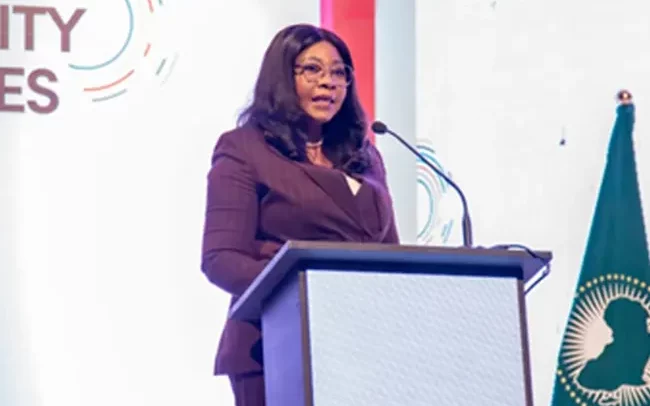
Mrs. Matilda Asante-Asiedu speaking at the event
More than 80 percent of intra-African payments routed through correspondent banks outside the continent, largely in foreign currencies, cost Africa an estimated US$5.3 billion annually exposing economies to significant foreign exchange risks.
Delivering a speech on behalf of the Governor of the Bank of Ghana at the 2026 Africa Prosperity Dialogues in Accra, Second Deputy Governor of the Bank of Ghana, Matilda Asante Asiedu, noted that despite these challenges, Africa stands at the threshold of tremendous opportunities if it aligns its payment systems with its trade ambitions.
According to her, the African Continental Free Trade Area (AfCFTA) brings together a market of over 1.5 billion people with a combined GDP of approximately US$2.8 trillion.
She explained that if the (AfCFTA) is fully implemented, intra-African trade could double in the medium term, but mentioned that such growth would only materialise if Africa develops efficient, secure, and affordable payment systems.
“As Africa advances the implementation of AfCFTA, one truth has become increasingly clear, trade agreements alone do not make trade payments possible,” she said.
She also added that without reliable means of transferring value, the vision of a truly integrated African market cannot be achieved, describing payment systems as strategic trade infrastructure critical to monetary stability, financial integration, and long-term economic transformation.
Highlighting some challenges facing payments systems, Mrs. Asiedu said cross-border payments in Africa remain expensive, slow, and fragmented with transaction costs for intra-African payments, often exceeding 7 to 10 percent, compared to a global average of about 3 percent, and settlement times spanning from days to weeks.
While acknowledging Africa’s global leadership in digital finance, innovation, she pointed out that the continent hosts more than half of the world’s mobile money accounts citing Ghana as an example of a country whose digital finance has become a lifeline for households, micro enterprises among others.
“In Ghana, we have deliberately built a modern, interoperable, and resilient payment ecosystem. Investments in digital public infrastructure have enabled real-time payments across banks, mobile money operators, and fintech institutions,” the second Deputy Governor added.
She indicated that some of the challenges could be addressed through harmonisation of regulatory standards across Africa, consumer protection, data sharing, and dispute resolution while also advocating for license passporting across countries, strengthening digital public infrastructure and expanding cross-border mobile money and instant payment pilots, and improving digital onboarding for Small Medium Enterprises (SMEs).
She further said that Africa’s single market cannot be achieved by aspiration alone but by systems that allow value to move as seamlessly as ideas.
“If we innovate with purpose, collaborate with conviction, and build strong institutions, cross-border payments can transform from a constraint into a powerful catalyst for Africa’s shared prosperity,” she stated.
By Ebenezer K. Amponsah