
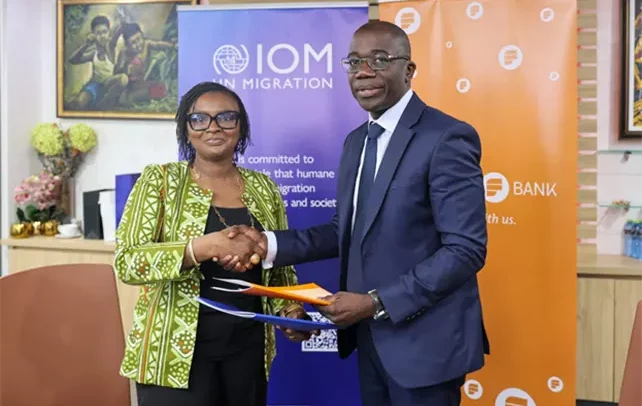
Fatou Diallo Ndiaye and Julian Opuni, exchanging documents
The International Organization for Migration (IOM) Ghana has entered into a strategic partnership with Fidelity Bank Ghana Limited to deepen financial inclusion and entrepreneurship capacity among Ghanaian returnees, in a move aimed at strengthening local enterprise growth and economic resilience.
The agreement, formalised in Accra on February 10, 2026, will see Fidelity Bank train 500 returnees across the Bono, Bono East, Ashanti and Greater Accra regions in essential business and financial management skills.
The programme focuses on budgeting, remittance management, savings culture and basic business finance such as tools considered critical to helping returnees rebuild livelihoods and integrate sustainably into the local economy.
The initiative is being implemented under IOM’s Empowering Ghanaian Returnees with Financial Literacy Skills project, which seeks to bridge a long-identified financing and knowledge gap among migrants who return home, often with limited capital and little access to structured financial services.
For the nation’s private banking sector, the partnership represents an expanding role in social impact financing and grassroots enterprise development.
Speaking at the signing ceremony, Managing Director of Fidelity Bank, Julian Kingsley Opuni, said the collaboration aligns with the bank’s long-standing strategy of community-based banking and inclusive growth.
“At Fidelity, we have always taken banking into our markets and communities and built systems to ensure that language is never a barrier in understanding finances,” he noted.
“This partnership validates that grassroots approach. We are proud to bring our practical experience to returnees, providing the financial roadmap they need to rebuild their lives with dignity and stability,” he added.
According to him, financial literacy remains one of the most decisive factors in determining whether returnees transition successfully into entrepreneurship or formal employment.
Since 2017, more than 7,000 Ghanaians stranded along dangerous migration routes have returned home with support from IOM under the Migrant Protection, Return and Reintegration Programme.
However, many struggle to convert reintegration grants or remittances into sustainable income streams due to limited business knowledge and restricted access to formal banking services.
IOM Chief of Mission for Ghana, Togo and Benin, Fatou Diallo Ndiaye, described reintegration as a process rather than an event, emphasising that long-term success depends on economic empowerment.
“Reintegration isn’t an end point; it’s a new beginning. When we equip people with the right financial tools and knowledge, we are investing in sustainable development for entire communities,” she said.
She indicated that the programme also underscores a broader shift in development financing such as one that increasingly relies on public-private partnerships to scale impact.
By leveraging Fidelity Bank’s branch network and community presence, IOM aims to extend financial education beyond classroom sessions to practical, market-based engagement.
Ms. Ndiaye argued that private sector involvement enhances sustainability by embedding returnees within mainstream economic systems rather than isolating them in short-term aid programmes.
Through structured financial training, she pointed out, returnees are expected to improve savings discipline, access formal credit and build viable micro and small enterprises that contribute to local job creation.
The initiative is supported by the European Union under the Migrant Protection, Return and Reintegration Programme for Sub-Saharan Africa (MPRR-SSA), reinforcing the EU’s commitment to safe migration management and economic stabilisation in origin countries.