
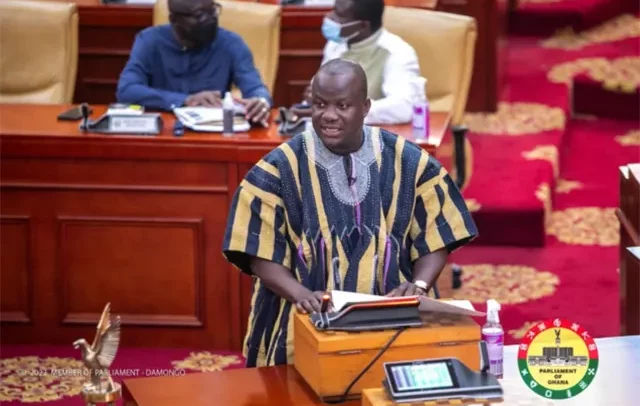
Samuel Abu Jinapor
Heated exchanges erupted in Parliament yesterday as Majority and Minority Members clashed over the recent reduction in cocoa producer prices, with each side blaming the other for the challenges confronting the sector.
The New Patriotic Party (NPP) Member of Parliament (MP) for Damongo, Samuel Abu Jinapor, described the price cut as a direct result of “gross mismanagement” and poor judgement by the current administration.
According to him, the crisis in the cocoa sector has nothing to do with external shocks but rather the government’s failure to properly understand international cocoa trading dynamics.
“The reason why we are in this mess is because the government made poor judgement when it comes to trading,” he argued, adding that the government failed to take advantage of forward sales and spot sales opportunities when global cocoa prices peaked at around $11,000 per tonne.
Mr. Jinapor stressed that the cocoa industry predates Ghana’s independence and remains central to the country’s economy, with about one million Ghanaians directly and indirectly engaged in the sector, representing nearly four million livelihoods.
He rejected claims that mounting debt was responsible for the price cut, noting that previous administrations, including that of former President Nana Akufo-Addo, inherited significant cocoa sector debts but still maintained or increased producer prices.
He further pointed to neighbouring Côte d’Ivoire, arguing that despite facing similar global conditions, it is currently paying its farmers more than Ghana.
“Never in the history of our country since President Kwame Nkrumah’s time have we had such a reduction in cocoa prices,” he said, insisting that the situation reflects poor decision-making rather than unavoidable economic pressures.
Adding his voice, NPP MP for Ofoase-Ayirebi, Kojo Oppong Nkrumah, warned that the reduction could erode trust and credibility in government policy.
He recalled that during previous downturns on the global market, the NPP government did not reduce cocoa prices. Instead, prices rose significantly over the years despite fluctuations internationally.
He accused the current administration of reneging on campaign promises, arguing that farmers were initially promised higher returns.
“Within the same cocoa year, you promised a price of GH¢3,600 only to reduce it to about GH¢2,500 before the year ends,” he said, calling on the government to restore the earlier price.
However, the National Democratic Congress (NDC) MPs strongly rejected claims of mismanagement.
The Member of Parliament for Bodi, Sampson Ahi, attributed the current difficulties to what he described as the “mess” inherited from the previous administration.
He disputed assertions that Côte d’Ivoire had maintained higher producer prices, arguing that if that were the case, farmers would not be appealing to the government to purchase their cocoa whenever international prices fluctuate.
Mr. Ahi further alleged that under the previous government, significant loans were contracted for cocoa rehabilitation and procurement, including facilities from the African Development Bank, but the intended outcomes were not fully realised.
Similarly, the NDC MP for Amenfi West, Eric Afful, accused the NPP of hypocrisy, claiming that during its tenure it collapsed Produce Buying Companies (PBCs) and mismanaged substantial cocoa-related financing.
By Ernest Kofi Adu, Parliament House