
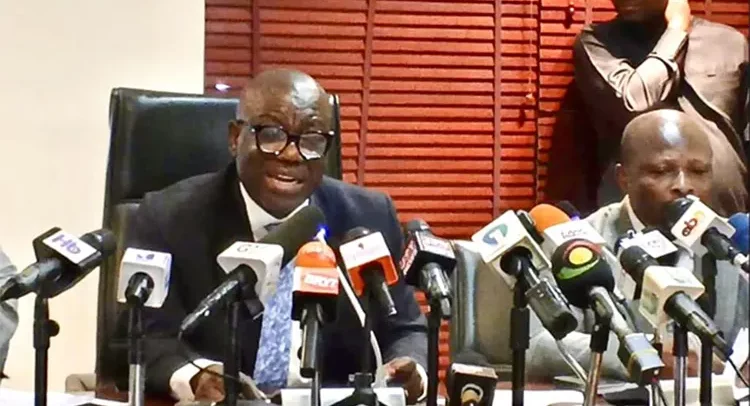
Isaac Adongo (L) addressing the media in Parliament
The Majority caucus in Parliament has defended the government reforms in the cocoa sector, insisting that farmers remain economically better off despite recent producer price adjustments.
Addressing the media in Parliament yesterday, Chairman of the Finance Committee and Member of Parliament (MP) for Bolgatanga Central, Isaac Adongo, indicated that cocoa farmers are able to acquire more building materials such as roofing sheets with current earnings than under previous pricing regimes.
Speaking on the financial state of the Ghana Cocoa Board (COCOBOD), the National Democratic Congress (NDC) lawmaker argued that sweeping debt restructuring, government intervention and broader economic management have improved the purchasing power of cocoa farmers even as nominal prices declined.
Mr. Adongo, flanked by his colleagues, disclosed that the government has begun aggressively paying down COCOBOD debts inherited, including an African Development Bank facility of about GH¢8 billion.
According to him, GH¢1.2 billion of the principal has already been repaid, alongside GH¢165 million in interest obligations.
He further revealed that a Bank of Ghana loan with a principal of GH¢1.3 billion was converted into equity to recapitalise COCOBOD and relieve the institution of servicing pressures.
He added that interest liabilities associated with that facility were also absorbed as part of the recapitalisation effort.
The Majority noted that additional liabilities, including GH¢9.3 billion in cocoa bonds, GH¢3.7 billion in non-marketable bills and operational debts owed to local cocoa processors, have either been serviced or converted into equity to strengthen the board’s balance sheet.
He explained that the restructuring programme commenced prior to the recent formal reform announcement by the Finance Ministry, describing it as a deliberate effort to restore COCOBOD’s financial health and operational viability.
Mr. Adongo also justified the government’s decision to transfer cocoa road commitments valued at more than GH¢26 billion to the Roads and Highways Ministry, arguing that road construction fell outside COCOBOD’s core mandate.
He said GH¢4.4 billion worth of projects had been reviewed and reassigned accordingly.
The MP criticised what he described as past procurement excesses and borrowing practices, claiming these contributed to the current financial strain facing the cocoa regulator.
He cited instances of outstanding contracts, unused inputs at ports and borrowing to repay earlier obligations as indicators of mismanagement.
Despite these challenges, Mr. Adongo maintained that the government interventions were ultimately designed to protect farmers and ensure long-term sustainability of the cocoa sector.
“You cannot maintain the same producer price when world market prices have dropped by more than 70 percent,” he stated, adding that responsible leadership required difficult decisions to preserve the viability of the sector.
Mr. Adongo disclosed that government had released GH¢855 million to settle outstanding payments owed to cocoa buying companies, a move expected to facilitate prompt payments to farmers.
He emphasised that sustaining COCOBOD operations requires working capital exceeding GH¢30 billion annually, covering cocoa purchases, buyer margins and evacuation costs.
Without reforms, he warned, the institution risked deepening losses that had already risen sharply in recent years.
The NDC MPs announced plans for legislative reforms to redefine COCOBOD’s mandate, restrict non-core activities and improve governance standards.
The reforms, they said, would also prioritise domestic processing and restore investor confidence in the cocoa industry.
The Majority argued that while farmers may prefer higher headline prices, safeguarding the financial stability of COCOBOD was essential to guarantee continuous support, stable payments and future growth of the nation’s cocoa economy.
By Ernest Kofi Adu, Parliament House