
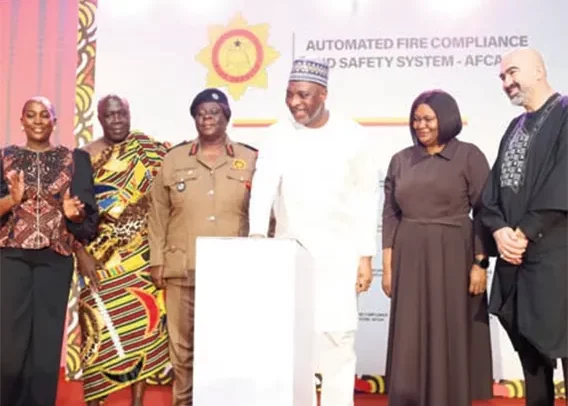
Muntaka Mohammed-Mubarak (3rd R) with dignitaries in a group photograph
The Ministry of the Interior, in collaboration with the Ghana National Fire Service (GNFS), has introduced the Automated Fire Compliance and Safety System (AFCAS), a digital platform designed to transform fire safety compliance nationwide.
Speaking at the launch, the Minister for the Interior, Muntaka Mohammed-Mubarak, described the initiative as a decisive step toward modern, responsive and technology-driven public service delivery, particularly in the critical area of public safety. He stressed that fire safety is not a luxury but a national necessity that safeguards lives and property, strengthens investor confidence and supports national development.
With rapid urban expansion, industrial growth and increasing infrastructure investments, he noted that the need for an efficient, transparent and preventive fire safety compliance system has become more urgent than ever. AFCAS replaces manual, fragmented and time-consuming processes with a digital and standardised regime.
”Through the system, the Ghana National Fire Service will streamline inspections, reduce turnaround time, monitor compliance in real time and identify high-risk facilities for proactive intervention. The platform will also support evidence-based decision-making and long-term fire safety planning across the country,” he stated.
He commended the Chief Fire Officer for her leadership and commitment in driving the reform, and assured her of his full support to ensure the successful nationwide implementation of AFCAS.
He further called on property owners, developers, businesses, institutions and the general public to comply fully with fire safety regulations under the new system, warning that any officer who undermines its integrity will face disciplinary action and possible prosecution under the law.
The Chief Fire Officer, Daniella Mawusi Ntow Sarpong, said the introduction of AFCAS marks a deliberate shift from manual, paper-based processes to a digital system designed to enhance efficiency, transparency and accountability.
She noted that previously, inspections were difficult to track, turnaround times were long, and both the public and the Service faced avoidable frustrations.
According to her, the new digital platform will improve interaction with the public, better coordinate inspections, enable real-time compliance tracking and ensure early identification of fire risks.
”The system will strengthen preventive fire safety measures and support national development rather than delay it,” she emphasised.
The Chief Fire Officer further stated that AFCAS will introduce a reliable and structured revenue stream for the Service, reduce overreliance on government subvention as well as enhance financial capacity to build and maintain operations.
She assured that the Service remains fully committed to the nationwide implementation of AFCAS, positioning the institution as a more efficient, technology-driven and forward-looking public safety agency.
The Deputy Director of Safety for Ghana National Fire Service, DOI Michael Ato Korsah, explained that AFCAS is designed to enhance efficiency, effectiveness and transparency in fire safety regulation.
He stated that the system is built around key functional areas including certification, specialised training, revenue mobilisation and compliance monitoring tools to strengthen the operations of the GNFS.
”Under certification, AFCAS will cover new and existing facilities, including commercial properties seeking loans, to ensure proper fire risk assessment before financial approvals are granted,” he noted.
DOI Korsah added that the system introduces wiring certification supported by thermal imaging technology to assess electrical installations and detect potential fire hazards. AFCAS will also ensure that imported materials and safety installations meet approved fire rating standards before certification is granted.
He further indicated that specialised training and rescue services will form part of the system, requiring institutions to train and certify personnel as a prerequisite for fire certification. This, he said, will strengthen preparedness and compliance.
” AFCAS will introduce a digital tracking platform to monitor fire safety equipment, including extinguishers assigned to vehicles, by linking serial numbers to specific vehicles to prevent misuse. Servicing points will also be established nationwide to improve access to extinguisher maintenance,” he revealed.
Additionally, he said the system will incorporate real-time monitoring and surveillance options for institutions, to enhance emergency response time and improve coordination during fire incidents.
By Janet Odei Amponsah