
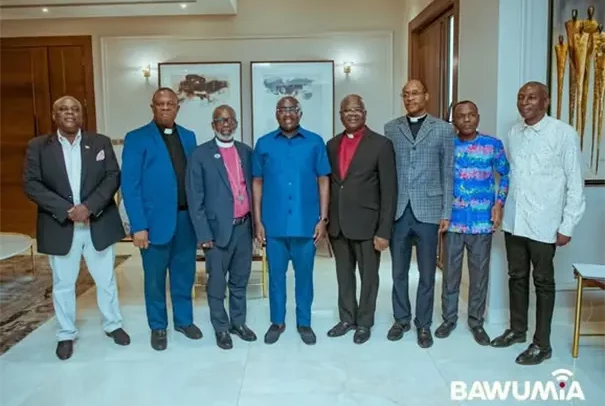
The delegation praying with the host during the visit
The Christian Council of Ghana (CCG) has stepped into the prophecy frenzy that has gripped a section of pastors in the country.
The CCG, while taking exception to the phenomenon, called for a more responsible, ethical, and sound prophecies in the country’s religious plane.
The recent 2026 national flagbearer primary of the New Patriotic Party (NPP) in which former Vice President Dr. Mahamudu Bawumia was victor, showed conflicting prophecies about the results. This prompted questions about the credibility of the prophecies, with cynics pointing at monetary rewards as the motivating factors for the forecasts.
Some observers even think that the prophets became pawns in a mind-game puzzle created at the instance of contesting politicians.
The CCG, while frowning upon the trend and the impression that God releases conflicting results, asked, “How can the same God be seen as revealing opposing results to different individuals?” This theological dilemma raises questions about the consistency and nature of God’s will, with the CCG urging a deeper reflection on how prophecies should be used in public discourse.
The Council emphasised the importance of aligning prophecies with God’s true will, which encompasses not just political events but also the moral, socio-economic, and spiritual health of the nation. Addressing the issue of misused prophecies, the CCG reiterated that religion should not be a vehicle for fear-mongering, panic, or public unrest. In line with Ghana’s laws, which prohibit false statements that could disturb public peace or create unnecessary alarm, the CCG warns that prophets or religious leaders who spread misleading prophecies could face legal consequences under the Criminal Offences Act and the Electronic Communications Act.
Acknowledging the diversity of religious groups in Ghana and the challenge of regulating unregistered prophets, the CCG still calls for greater responsibility in the prophetic practice, urging prophets to exercise caution, integrity, and theological soundness.
Religious leaders, especially those using platforms like pulpits and social media, must ensure their prophecies do not mislead or cause harm to society. Prophetic messages must stand the test of scripture, promote peace, and work towards the common good, the CCG maintained.
“The Christian Council calls on Ghana’s prophetic voices to focus on addressing pressing issues like corruption, nepotism, poor governance, and environmental justice, while fostering peace and social harmony.
“As Christians enter the season of Lent and Muslims observe Ramadan, this period of reflection offers an opportunity for all to reconsider how their faith can better serve the national interest. Rather than propagating divisive or unverified prophecies, religious leaders are encouraged to focus on the positive and transformative power of true prophecy—one that promotes moral values, national prosperity, and justice for all citizens,” the CCG stated.
In a related development, the CCG paid a courtesy call on former Vice President Dr. Bawumia following his recent victory in the NPP’s flagbearer polls held across the country.
The delegation was led by Rev. Enoch Nii Narh Thompson, who congratulated the former Vice President and expressed the Council’s goodwill to him.
In a Facebook post, the former Vice President expressed gratitude to the delegation and reiterated commitment to continue to collaborate with faith-based organisations for the development of the country.