
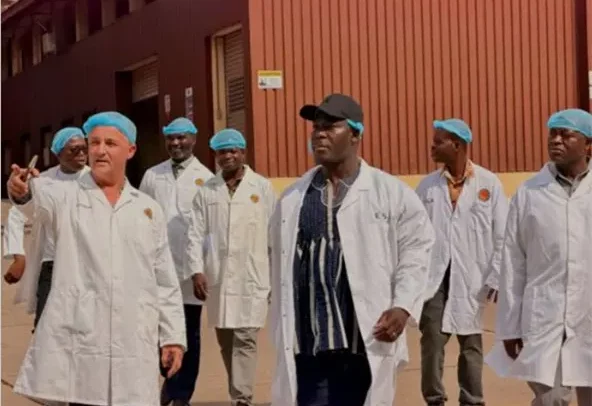
Managing Director of WAMCo, Frank Bednar (L) taking his guests round the company
The West African Mills Company (WAMCo), a cocoa processing company in Takoradi, has reaffirmed its commitment to scaling up production in line with the government’s vision to process at least 50 percent of cocoa locally.
The policy, announced by President John Dramani Mahama, is intended to strengthen the cocoa value chain, boost local employment, and drive economic growth.
This is to be achieved by increasing in-country cocoa processing through local processors.
This came to light when the Managing Director of the Cocoa Marketing Company (CMC), Dr. Wisdom Kofi Dogbey, paid a working visit to WAMCo in Takoradi. He visited the premises of the cocoa processing company to, among other things, assess its readiness ahead of the government’s directive.
The visit also formed part of efforts to align industry players with the reform, which incorporates CMC’s “Project Elevate”, an initiative aimed at converting raw cocoa into semi-finished products for export.
It marked a significant step in CMC’s broader strategy to drive cocoa value addition and expand export opportunities.
By strengthening partnerships with processors and aligning with national policy, CMC aims to enhance the sector’s contribution to the country’s economy.
Dr. Dogbey said that as the industry prepares for the transition, the commitment of both government and key stakeholders is critical, as it signals a positive outlook for Ghana’s cocoa processing sector and its competitiveness in global markets.
He took the opportunity to assess WAMCo’s processing capacity, infrastructure, and operational readiness to meet the new requirements.
He stressed the importance of preparing facilities to handle increased volumes and higher quality standards.
“It is crucial that we prepare our processing facilities to handle the increased capacity and quality standards that will come with the reform,” he stated.
Dr. Dogbey underscored the need for collective action across the cocoa value chain to ensure the successful implementation of the reform.
“This is not just a government initiative; it is a collective responsibility that requires the active participation of all stakeholders,” he added.
The engagement also included discussions with WAMCo executives on production targets, pricing, demand, technology investments, and quality certifications needed to support the transition.
Management of WAMCo highlighted ongoing efforts to upgrade certifications and improve operational efficiency to meet the growing demand for semi-finished cocoa products.
From Emmanuel Opoku, Takoradi