
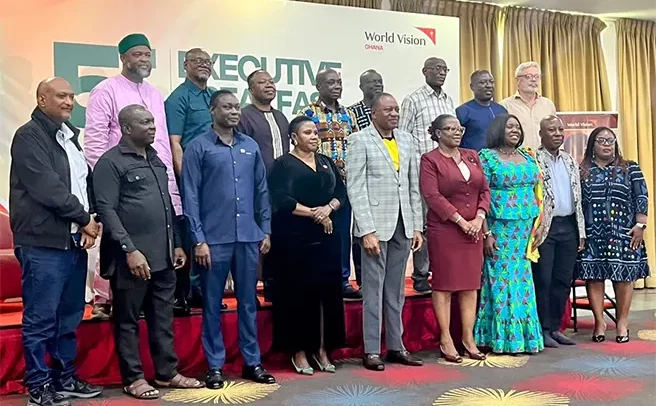
Officials in a group photograph
Director-General of National Development Planning Commission (NDPC), Dr. Audrey Smock Amoah, has stated that the decision to incorporate sanitation indicators into the performance assessment of metropolitan, municipal, and district chief executives, and also in the performance contracts of Metropolitan, Municipal and District Assemblies (MMDAs), reflect an important recognition that sanitation outcomes are directly linked to leadership, accountability, and effective service delivery.
She said this during the 5th Multi-Stakeholder Executive Breakfast Conversation 2026 on sanitation in the context of job creation, the economy and more.
The event was themed: “Sanitation as a Key Performance Indicator for MMDCEs and the Role of Relevant Ministries, Departments and Agencies – Prospects, Opportunities and Constraints.”
Dr. Amoah, who chaired the event, emphasised that the event also signals a broader understanding that achieving national water, sanitation, and hygiene (WASH) objectives requires strong local ownership, coordinated action among relevant ministries, departments, and agencies, and measurable results that improve the well-being of citizens.
She explained that, the district assembly’s Common Fund Utilisation Guidelines has redefined 20% of allocations for WASH, 10% for potable water, and 10% for environmental sanitation.
”This dedicated financing is designed to eradicate water poverty, expand safe drinking water access in rural and marginalised communities, and further accelerate progress towards open defecation, free environment, while closing persistent public health and waste management gaps,” she explained.
”Looking ahead, the Ghana Infrastructure Plan 2018-2047 envisions transformative outcomes, 99% of households rely on pipe water as their primary source, non-revenue water reduced to 10%, and safe sanitation accessible to 95% of the population,” she said.
According to her, attaining Ghana’s ambitious WASH targets requires that persistent challenges be tackled collectively in the short and beyond-the-long term.
These challenges, according to Dr. Amoah, include; increasing rural-urban migration-trained infrastructure, open defecation, poor sanitation practices, weak enforcement of sanitation bylaws, climate-related flooding, limited behavioural change and capacity gaps at the local government level.
Dr. Amoah proposed five foundational pillars to guide national strategy and deliberation, and these foundational pillars are; water and sanitation being treated not as a social expenditure but as a productive asset central to industrialisation, climate resilience, and food systems, as well as energy transitions. Also, shared resources must become shared opportunities, and compliance and accountability must be essential to ensure that investments translate into real improvements in service delivery and public health.
Again, she further added that “innovative financing mechanisms, stronger private sector engagements, and sustained collaboration with civil society and development partners are needed to close gaps and sustain interventions as well as work to track progress rigorously, speak with one voice, and make evidence-based results the foundation of our collective strategy.”
Highlighting critical gaps, the National Director of World Vision Ghana, Dr. Tinah Mukunda, noted that the open defecation situation remains unchanged since 2015, even as other sub-Saharan African countries have achieved a 15% reduction. This stagnation, according to Dr. Mukunda, poses an unresolved crisis threatening public health and the socio-economic well-being of families.
To drive progress, Dr. Mukunda commended President John Dramani Mahama and the government for implementing recommendations from previous summits. Specifically, environmental sanitation has been integrated into key performance indicators for Metropolitan, Municipal and District Assemblies, supported by a dedicated 10% allocation from the District Assemblies Common Fund.
Deputy Minister for Local Government, Chieftaincy and Religious Affairs, Rita Naa Odoley Sowah, stated that nearly 40% of households still lack access to household toilet facilities and significant numbers of citizens continue to practice open defecation.
She highlighted that the decision by governments to make sanitation a key performance indicator for Metropolitan, Municipal and District Chief Executives is indeed one of the clearest signals pointing to the fact that Ghana is determined to move sanitation from this periphery of governance to the very centre of local governments.
”The cleanliness, health, and environmental condition of the communities under its jurisdiction must equally matter. Sanitation is a governance issue, it is a public health issue, an economic issue,” she said.
She thus officially declared the event open and launched the Seventh School Sanitation Solutions Challenge, highlighting critical national data and pivotal local governance reforms.
Minister for Labour, Jobs, and Employment, Hassan Abdul-Rashid Pelpuo, emphasised that sanitation is directly linked to labour and economic development.
He mentioned that, the sanitation value chain presents significant opportunities for enterprise development and employment creation, particularly for youth and women in fields like waste collection, recycling, and resource recovery.
The minister also stressed that promoting decent work, safe labour practices, and community co-investment to foster a sustainable and productive workforce is very essential.
By Janet Odei Amponsah