
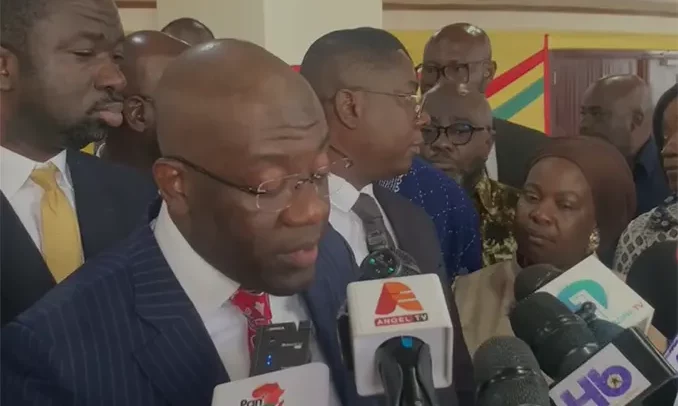
Kojo Oppong Nkrumah addressing the media
The Minority Caucus in Parliament yesterday boycotted a scheduled briefing by the Governor of the Bank of Ghana (BoG), Dr. Johnson Asiama, after the Majority voted to exclude the media from covering proceedings of the Committee of the Whole.
The boycott followed a disagreement between the two sides over whether journalists should be allowed to witness the Governor’s appearance before Parliament to answer questions on the Bank’s foreign exchange market interventions, reserve management and financial performance.
Addressing journalists after suspending their participation, the Ranking Member on Parliament’s Economy and Development Committee, Kojo Oppong Nkrumah, accused the Majority of attempting to conceal critical information from the Ghanaian public.
According to him, the Minority had filed three questions for the Governor seeking to establish the source of the foreign exchange being used to support the cedi, the framework governing the Bank’s foreign exchange interventions and the total amount injected into the market.
He said the questions had become necessary following months of public debate over the Bank’s management of the exchange rate and concerns about its growing financial losses.
“At the end of the day, the people of Ghana will pay. That is why we are raising these questions so that we can also share other risks that we are not paying attention to,” Mr. Oppong Nkrumah said.
Forex Source
The former Works and Housing Minister claimed the Governor’s written responses, already captured on Parliament’s Order Paper, indicated that since August 2024 the Bank had not relied on its foreign reserves for direct market interventions.
Instead, he said, the Governor explained that the interventions had been financed with foreign exchange proceeds generated through the Domestic Gold Purchase Programme.
Mr. Oppong Nkrumah argued that the response confirmed that the Bank was mobilising forex from the gold purchase programme to support the cedi, contrary to what he suggested had been the government’s public narrative.
He questioned why the Majority would prevent the Governor from publicly explaining the policy if the responses had already been officially submitted to Parliament.
The Minority also expressed concern that the strategy could undermine the nation’s reserve accumulation efforts by diverting foreign exchange that could otherwise strengthen the country’s reserve position.
Mr. Oppong Nkrumah further alleged that the Bank had provided outdated figures on the volume of forex injected into the market, saying the Governor’s responses did not contain the latest data and that follow-up questions would have sought clarification.
He also raised concerns about what he described as additional losses at the central bank, insisting that Parliament was yet to receive the Bank’s audited accounts through the Finance Minister as required by law.
According to him, Parliament had a duty to scrutinise the Bank’s financial position because any losses ultimately become a burden on taxpayers.
The Minority maintained that preventing media coverage undermined Parliament’s commitment to transparency and accountability.
“This is the people’s House. This is where the people must hear the answers to all these questions,” Mr. Oppong Nkrumah said, adding that the Minority’s leadership would continue engaging the Majority in the hope that the proceedings would eventually be opened to the public.
Majority Responds
Responding to the boycott, the Majority Leader, Mahama Ayariga, dismissed suggestions that the Majority was attempting to hide information from the public.
He explained that under Standing Order 266, meetings of parliamentary committees, including the Committee of the Whole, may be held in public only if the committee so determines.
Mr. Ayariga said Parliament’s longstanding practice has been to hear independent constitutional bodies, including the Administrator of the District Assemblies Common Fund and the National Health Insurance Authority, without media coverage unless members expressly decide otherwise.
He argued that the Governor of the BoG should not be treated differently merely because the Minority insisted on television coverage.
According to him, the Governor had already prepared a press statement containing the answers to all the questions and was ready to make it available to journalists, which demonstrates that there was no attempt to conceal information.
“The Governor himself knew there would be journalists. His answers are already captured in a press release and he was willing to share them with the media,” Mr. Ayariga said.
He accused the Minority of prioritising “media optics” over parliamentary scrutiny, arguing that if their primary objective was accountability, they should have remained in the meeting to question the Governor directly.
By Ernest Kofi Adu, Parliament House