
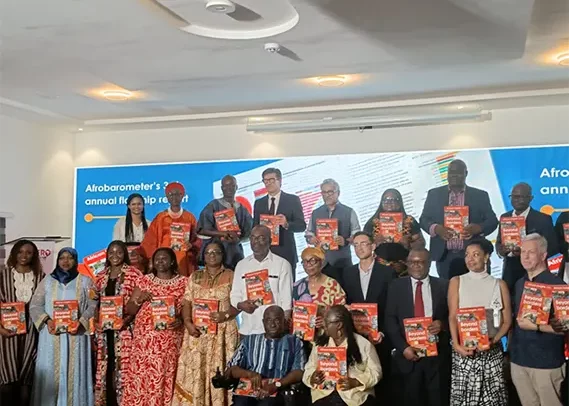
Participants with the report in hand
Afrobarometer report has revealed that nearly half of Africans have considered leaving their countries in search of better opportunities abroad as a result of unemployment, poverty and limited economic prospects.
According to the report, 25% said they had considered it “a lot” representing a 40% increase compared to figures recorded nearly a decade ago.
Afrobarometer’s third annual flagship report, based on Round 10 survey data collected across 38 countries in 2024/2025, examines how ordinary Africans view and experience global issues, including migration, international trade, climate change and Africa’s relations with major global powers.
According to the report, young and highly educated people are the most likely to consider leaving their countries as a result of economic hardship with 50% of migrants seeking employment opportunities while 29% will like to migrate due to poverty.
The report further revealed that migration preferences are shifting, with more Africans looking beyond the continent for opportunities stating that proportion of citizens who prefer migrating within Africa has declined from 36% in 2016/2018 to 26% currently.
While Africans remain generally welcoming towards foreigners, the report found that concerns about economic competition have influenced attitudes towards immigration indicating that 77% of Africans would welcome or would not mind having immigrants as neighbours.
The report also showed that many are cautious about the economic impact of migration, as 64% preferred fewer or no job seekers admitted into their countries, while 70 per cent expressed similar concerns about refugees.
The report also identified a different migration pattern compared with other regions, noting that the most educated, skilled and wealthier citizens in Africa’s relatively stronger economies are among those showing greater resistance to immigration.
AfCFTA
Beyond migration, the Afrobarometer report highlighted Africans’ support for international trade despite limited awareness of major continental economic initiatives.
It found that only 13% of Africans have heard about the African Continental Free Trade Area (AfCFTA), although the agreement is intended to boost economic integration and expand trade across the continent.
Despite the low awareness, support for open trade remains strong, with 62% Africans believe it is better for their economies to make trade easier with other countries, compared with 51% five years earlier.
The report also showed that 66% of Africans want their governments to expand trading relationships globally, suggesting that citizens are looking beyond regional markets for economic opportunities.
Speaking in an interview with a section of journalists on the report, the United Nations Development Programme (UNDP) Resident Representative in Ghana, Niloy Banerjee, said Africa must focus on creating conditions that encourage citizens, particularly young people, to thrive on the continent.
He said migration decisions were often influenced by the availability of opportunities, adding that people would be less likely to leave if they could access jobs, quality education, healthcare and improved living standards while calling for greater efforts to make AfCFTA to work effectively.
“We have to show results. We have to show that AfCFTA is working for the African producer, manufacturer and trader, that Africa must demonstrate the benefits of continental trade integration for producers, manufacturers and businesses,” he said.
The Chief Executive Officer of Afrobarometer, Dr. Joseph Asunka, said the findings showed that Africans support greater economic cooperation but remain disconnected from some major policy initiatives, particularly the AfCFTA.
He said governments needed to improve communication about the agreement and ensure citizens understood how it could improve livelihoods.
Dr. Asunka also emphasised the need for collective continental action to create opportunities for young Africans, arguing that stronger infrastructure and regional cooperation would help businesses access larger markets.
“If young people want to create their own businesses, those businesses can only thrive if they have a larger market,” he said.
The Director of Communications at Afrobarometer, Josephine Sanny, explained that the report was designed to bring the voices of ordinary Africans into global conversations on migration, trade, climate change and international relations.
She said the research showed that while Africans were increasingly interested in global engagement, governments must address domestic economic challenges to reduce migration pressures.
The report further mentioned that Africans are not interested in choosing sides in global power competition but are seeking partnerships that deliver tangible development benefits for their countries.
By Ebenezer K. Amponsah