
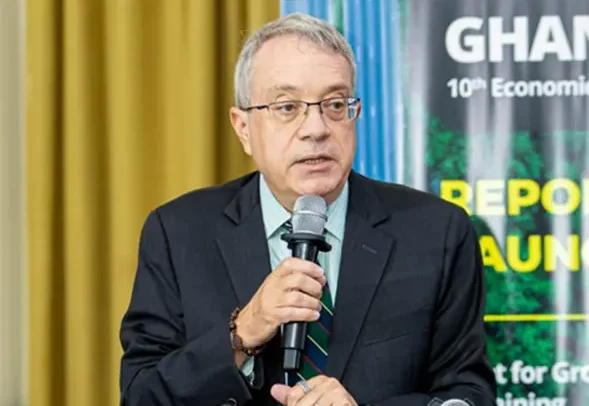
Dr. Robert Taliercio O’Brien
The World Bank has stated that 56.4 per cent of Ghanaians remain in poverty, with widening spatial disparities exposing a disconnect between headline economic growth and improvements in the living standards of most Ghanaians.
Speaking at the launch of the 10th Ghana Economic Update, published in August 2026 in Accra, the World Bank Country Director for Ghana, Liberia, and Sierra Leone, Dr. Robert Taliercio O’Brien, said although Ghana had made significant progress in restoring macroeconomic stability following the 2022/2023 economic crisis, the benefits of the recovery were yet to reach a large section of the population, particularly as growth remained concentrated in sectors with limited capacity to absorb the country’s growing labour force.
“56.4% of Ghanaians remain in poverty, and spatial disparities are widening. A disconnect between the headline growth that is yet to reach most of the population”.
“Growth is led by sectors with limited economic absorption relative to the young population entering the labour market in the next decade. This is a structural imbalance that demands urgent attention,” he stated.
The report, which assesses Ghana’s progress in restoring macroeconomic stability, also examines how reforms in the transport sector could support long-term growth, job creation and economic transformation.
According to the World Bank, Ghana’s economy grew by 6% in 2025, the fastest pace since 2019, before the COVID-19 pandemic, and accelerated further to 6.4 per cent in the first quarter of 2026 while inflation also declined significantly, falling from 23.2 per cent in February 2025 to 3.2 per cent in March 2026, as the lowest level since 1999 and currently stands at 4.6 percent.
The World Bank said growth was projected at 4.8 per cent in 2026 and expected to converge to around five per cent over the medium term, while inflation was expected to remain within the target range and public debt to stay on a sustainable trajectory.
Dr. O’Brien, however, cautioned that the recovery remained incomplete as some of the fiscal gains had been achieved through expenditure compression rather than stronger revenue mobilisation.
“The fiscal surplus was achieved largely through expenditure compression. Capital spending was 38 per cent below budget, which is not a sustainable path to growth and development. Sustained fiscal consolidation would require Ghana to strengthen domestic revenue mobilisation, describing revenue generation as a long-standing challenge for the country”he added
The Country Director further warned that delays in the energy sector recovery programme were imposing significant costs on the economy, while financial and operational inefficiencies within the cocoa sector were affecting farmers and putting pressure on public finances.
He called for far-reaching reforms to the legal and institutional framework governing the cocoa sector to promote market-based principles and minimise fiscal risks.
Dr. O’Brien said the concern underpinned the focus of the 10th Ghana Economic Update on the country’s transport sector, which the Bank believes has a critical role to play in improving connectivity, reducing business costs and supporting broader economic transformation.
Despite the challenges, he commended the government for the difficult policy decisions that had contributed to the improvement in Ghana’s macroeconomic indicators as it deserves full credit for the difficult decisions that made the results possible.
He, however, stressed that the gains should not create complacency, noting that Ghana still had significant structural challenges to address before the benefits of economic growth could be widely felt across the population.
By Ebenezer K. Amponsah