
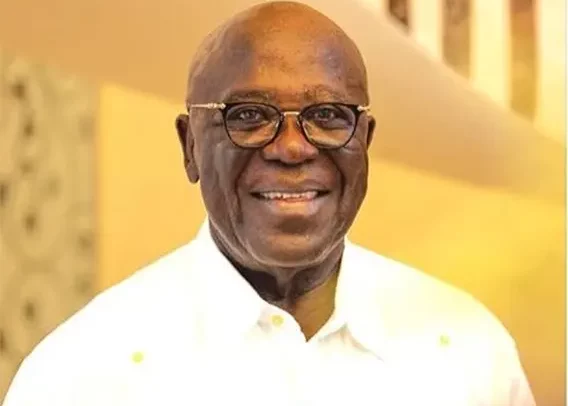
Sam Jonah
Mining magnate and business statesman, Sir Sam Jonah, has warned that the African Continental Free Trade Area (AfCFTA) risks becoming another failed African initiative if member states do not honour their commitments and make their economies competitive.
Speaking at the Global Business Forum — Ghana Edition at the La-Palm Royal Beach Hotel in Accra, Sir Jonah said the continent’s flagship trade project, headquartered in Accra, will not be killed by external powers but “by our own hand — border by border, permit by permit, prejudice by prejudice.”
“The Forum, held under the theme, “Building the World We Help to Create: Africa, Trade, Investment and Shared Prosperity,” brought together captains of industry, investors and government officials.
Sir Jonah said intra-African trade remains unacceptably low at 15 to 16 percent of total trade, compared to about 50 percent in Asia and over 60 percent in Europe.
He described Africa as a continent of 54 economies that trade past each other, exporting raw materials and importing finished goods.
“Ghana and Côte d’Ivoire together produce roughly 60 percent of the world’s cocoa. Yet of the vast global chocolate industry — worth well over a hundred billion dollars a year — we capture only a sliver. We grow the bean; others grow the wealth,” he said.
On the AfCFTA, which creates a single market of 1.4 billion people, Sir Jonah said agreements alone do not move goods.
He listed trucks, ports, payment systems that allow a trader in Tamale to settle with a supplier in Kigali in local currency, harmonised standards and border posts that open on time as the real drivers of trade.
“The AfCFTA has been signed. It must now be lived — in customs halls, in boardrooms, and in the daily choices of every procurement officer in this room,” he said.
He was blunt about two threats to the pact. First, competitiveness and how Africans treat one another.
“Nobody will buy African out of a sense of duty to the cause. Sentiment is not a supply chain. If we want Africans to buy from Africa, then African economies must earn the order,” he said.
Sir Jonah cited recent xenophobic attacks in South Africa, describing them as “a dagger aimed at the heart of continental integration” that could invite retaliation and make a free trade area unviable if citizens are not free to trade, work and live in safety across borders.
Recounting his personal experience, Sir Jonah disclosed that a significant real estate investment he made in Nigeria, a country he holds in high regard, has been subjected to sustained harassment by state agencies, with Ghanaian workers on the site enduring ill-treatment.
“If this is the experience of an investor with my resources, my networks and my grey hairs, what hope has the young entrepreneur with none of these? When African capital is harassed in Africa, we should not wonder why it flees to London and Dubai,” he said.
On capital, Sir Jonah said Africa faces a paradox of exporting its savings and importing expensive capital while pension funds sit in short-term instruments and the infrastructure gap widens. He argued that no continent has industrialised on rented capital alone and urged patient domestic capital.
He linked trade and investment to Africa’s demographic reality. With a median age of 19, and one in four people on earth expected to be African by mid-century, he said the youth bulge could be either a dividend or a crisis, depending on current choices.
Sir Jonah challenged governments to make implementation the new innovation, to harmonise and digitise systems and to protect African investors as zealously as foreign ones.
“The world is not a bequest. It is a construction site. And the only question that matters is whether we show up with our tools,” he said.
A Daily Guide Report