
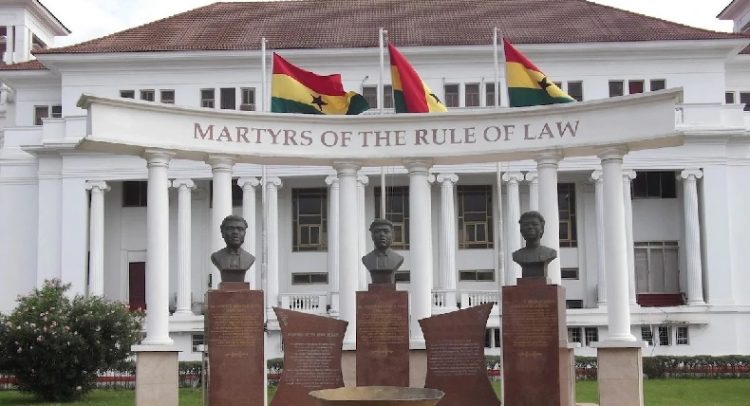
The Supreme Court (SC) has dismissed an application by Member of Parliament (MP) for Ofoase-Ayirebi, Kojo Oppong Nkrumah, seeking to reverse an earlier decision which refused to halt the implementation of the Chief Justice’s warrants which permitted selected courts to continue criminal trials during the legal vacation.
The review application had argued among others that the decision of the single judge was riddled with errors apparent on the face of the ruling.
A three-member panel of the court consisting Justices Emmanuel Yonny Kulendi (presiding), Richard Adjei-Frimpong, and Gbiel Simon Suurbaareh, said the application was without merit and failed to meet the threshold set by the court in previous cases.
Impugned Decision
The Supreme Court, on August 21, dismissed an application for injunction seeking to halt the Chief Justice’s warrant permitting two courts to hear the cases.
The court, presided over by a single judge, Justice Gabriel Pwamang, said the applicant failed to establish that the Chief Justice’s warrant was discriminatory.
According to him, Article 19(1) guarantees speedy trial of persons accused of criminal offences, and the framers of the constitution consider speedy trial so fundamental that under Article 14 clause 4 they provide that when there is an unreasonable delay in the trial of the person in detention, they may be released either conditionally or unconditionally.
Justice Pwamang also held that the warrants issued by the Chief Justice are part of efforts to provide an opportunity for more criminal cases to be heard expeditiously.
He said the fact that some criminal cases are not being heard during the legal vacation does not mean that the administration of justice would not be advanced to some extent by these hearings.
The application came on the back of a suit the MP filed at the Supreme Court challenging the constitutionality of the Chief Justice’s warrant permitting certain courts to continue the hearing of selected criminal cases during the legal vacation.
He contends that the Chief Justice’s action to promote and facilitate the hearing of ‘special criminal cases’ in the legal vacation to the neglect of other criminal cases amount to selective justice, which contravenes Article 17(1) of the Constitution and therefore unconstitutional, null and void.
Review
His lawyer, Frank Davies, who moved the application for review yesterday, said the single judge made definitive pronouncements in the ruling that go to the heart of the substantive case.
He said the single judge should have exercised restraint in maintaining the balance and not delve into the merits of the substantive matter which would be determined by the full Bench.
He also argued that the single judge was wrong in holding that the Attorney General could represent the Chief Justice in a matter that is challenging his administrative function, arguing that the Chief Justice ought to have a separate counsel in the matter.
Opposition
The application was opposed by Deputy Attorney General Dr. Justice Srem-Sai, who argued that it fell below the threshold set by the court and did not disclose any exceptional or special circumstances to warrant a grant of it.
He said the review jurisdiction of the court is not a stage for re-arguing matters which have already been argued before a single justice, adding “neither is the review jurisdiction a stage for an appeal.”
He contended that a careful perusal of the 40 paragraphs in support of the motion discloses no new facts, but rather contain the same issues, same facts reorganised.
“We therefore pray that when it comes to the question of injury which is reparable, the single justice’s findings must be left undisturbed. Also, when it comes to question of balance of inconvenience, no exceptional circumstance has been laid in this court and we therefore pray that the single judge’s decision be left undisturbed,” he added.
The court, in its ruling, said having taken all the processes filed into consideration as well as the oral arguments and precedents, the application did not meet the threshold of reversing the decision of the single judge, and therefore dismissed it.
It said the full reasons for the decision would be available on September 7, 2026.
BY Gibril Abdul Razak