
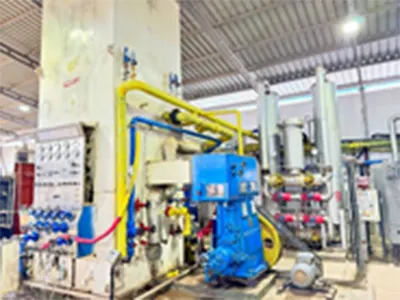
Indo-Ghana Industries Limited has begun supplying locally produced liquid medical oxygen to Ghanaian hospitals, marking a major shift in the country’s medical oxygen supply chain from cylinder-based distribution to a storage-based system aimed at reducing shortages and improving reliability.
The company delivered its first made-in-Ghana liquid oxygen supply to the LEKMA Hospital, where a cryogenic storage system has been installed to receive, store and distribute the product through the facility’s oxygen network.
Managing Director of Indo-Ghana Industries, Varun Tyagi, said the move addresses long-standing challenges associated with transporting medical oxygen in cylinders, including delays, high logistics costs and supply interruptions.
“Over the years, one of the biggest challenges when it comes to distribution of oxygen is that the packaging material, the cylinders, are much more expensive than the product itself,” he said.
Indo-Ghana, which began operations in Ghana in 2010, initially focused on the production and supply of gaseous oxygen.
The company expanded into liquid oxygen production after identifying distribution constraints that became more visible during the COVID-19 pandemic, when demand for medical oxygen increased sharply.
According to Mr. Tyagi, the cylinder-based model required hospitals to continuously request refills as empty cylinders were returned for replenishment, creating risks of delays caused by transportation challenges and road conditions.
The company said a single storage tank can hold the equivalent of about 1,000 cylinders of gaseous oxygen, allowing hospitals to maintain larger reserves and reduce frequent deliveries.
“At LEKMA, the quantity of liquid that we supplied can sustain them for a period of at least three months. They can now be assured that for the next three months they have oxygen available in their facility,” Mr. Tyagi said.
The transition has been supported by investments to equip hospitals to receive and store liquid oxygen.
Mr. Tyagi said the initial challenge was not only producing liquid oxygen locally but ensuring healthcare facilities had the infrastructure to accept it.
He said support from development partners, including USAID, CHAI and JHPIEGO, has helped provide liquid oxygen storage tanks to about 10 hospitals, while another five facilities received similar support through other programmes.
LEKMA Hospital’s Head of Clinical Engineering, Saviour Demordzie, said the new system has already improved oxygen availability at the facility by providing a more stable supply and reducing reliance on emergency cylinder deliveries.
“Our frequent calls for oxygen have reduced. There is a constant pressure and flow of oxygen at the facility. And because it is a liquid oxygen plant, we have a higher purity of oxygen delivered to the patient,” he said.
Indo-Ghana Engineer, Eduardo Bojador Bonifacio, said the new system improves efficiency by reducing manual handling and allowing automated supply through pipelines connected to hospital wards.
“This one can save time and minimise human error in supplying oxygen to patients,” he said. The company’s Apollonia Industrial Enclave facility currently produces about 10 tonnes of liquid oxygen per day and is planning additional capacity expansion.
Mr. Tyagi said the next phase is to develop a hub-and-spoke distribution model, where liquid oxygen production is concentrated at central facilities while smaller filling stations are established closer to hospitals across the country.
However, he identified challenges that could affect sustainability, including delayed payments from some hospitals, rising electricity costs and limited access to long-term financing.
He said electricity accounts for about 42 to 45 percent of production costs.
“Medical oxygen production falls under critical industry. There should be provisions to ensure that if there is any power reduction or outage, companies producing oxygen are informed early and arrangements are made so that they are not disconnected,” he said.
The company is engaging the Ministry of Health following the introduction of a national medical oxygen policy, which Mr. Tyagi said would support better monitoring of consumption, planning and supply management through telemetry systems in newly installed tanks.
A Daily Guide Report