
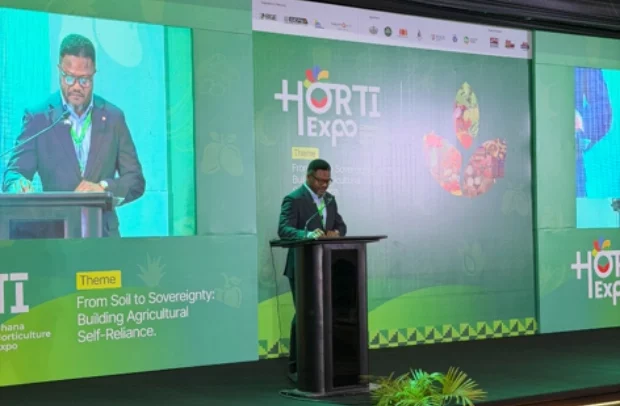
John-Paul Taabavi
Fidelity Bank Ghana has called for a fundamental shift in the way the nation finances and develops its agricultural sector, arguing that achieving agricultural self-reliance will depend less on producing more and more on capturing greater value from products already grown in the country.
The bank said greater investment in processing, storage, packaging, logistics, certification and other stages of the agricultural value chain was critical to increasing export earnings and retaining more wealth within the Ghanaian economy.
The call was made at the Ghana Horticulture Expo 2026, held under the theme, “From Soil to Sovereignty: Building Ghana’s Agricultural Self-Reliance Through Innovation.”
Speaking on behalf of the Managing Director of Fidelity Bank, Julian Opuni, the Divisional Director for Corporate and Institutional Banking, John Paul Taabavi, said the contrast between Ghana’s nontraditional agricultural exports and cocoa paste earnings illustrated the need for greater value addition.
He noted that nontraditional agricultural exports generated approximately US$710 million in 2025, while cocoa paste alone generated about US$789 million during the same period.
“Both were produced from the same soil, the same country, the same growing season,” Mr Taabavi said and added, “Yet the value of a single product exceeded the value of an entire category of agricultural exports. The difference lies largely in what happens after the harvest.”
According to him, agricultural sovereignty should not be defined by the nation’s ability to produce everything domestically, but by its capacity to control a greater share of the value created from its agricultural products.
He said the country must retain more income from agriculture and create opportunities for more Ghanaian businesses to participate in the wealth generated across the agricultural value chain.
Mr. Taabavi said Ghanaian agricultural products had reached 152 countries, with nontraditional exports reaching approximately US$5 billion in 2025.
He, therefore, argued that the major challenge was not necessarily a lack of international demand but the gaps between production and the final market.
He identified inadequate cold storage, aggregation, processing, packaging, logistics, quality standards, certification, reliable energy and access to appropriate financing as some of the key constraints limiting the sector’s potential.
Mr. Taabavi also called for a rethink of the conventional approach to agricultural lending, questioning whether farming was inherently risky or whether some of the risks were created by the way agricultural activities were financed.
He advocated financing models based on production cycles, verified transactions, credible off take agreements and warehouse receipts, rather than relying primarily on conventional collateral.
He cited the Fidelity Export Club, established in 2023 in partnership with the Federation of Associations of Ghanaian Exporters (FAGE), as an example of how targeted financing and partnerships could support agricultural exporters.