
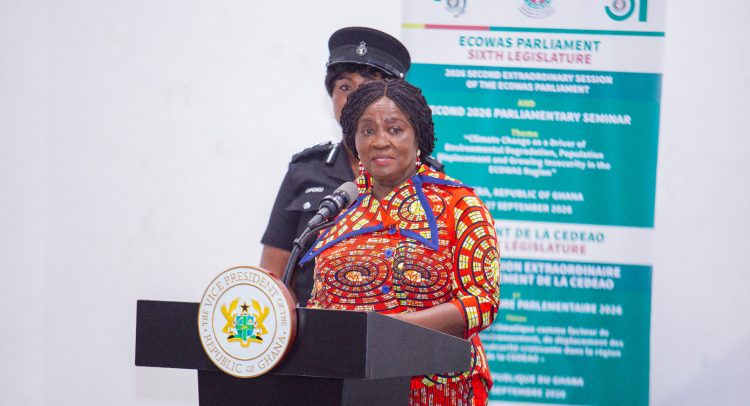
Vice President Prof. Jane Naana Opoku-Agyemang has called on member states of the Economic Community of West African States (ECOWAS) to strengthen cooperation and develop coordinated responses to the growing challenges of climate change, environmental degradation, population displacement and insecurity.
She said the interconnected nature of the challenges confronting West Africa required unified responses that addressed both their immediate effects and underlying causes.
Prof. Opoku-Agyemang made the call in Accra yesterday when she opened the Second 2026 Parliamentary Seminar and Second Extraordinary Session of the ECOWAS Parliament.
The seminar, which is being held from September 21 to 23, is on the theme: “Climate Change as a Driver of Environmental Degradation, Population Displacement and Rising Insecurity in the ECOWAS Region.”
According to the Vice President, West Africa continued to grapple with climate change and environmental degradation, with far-reaching consequences for livelihoods, food security and the well-being of citizens.
She said the pressures were being exacerbated by population displacement and growing insecurity, making it necessary for member states to strengthen cooperation and adopt coordinated regional approaches.
Prof. Opoku-Agyemang indicated that the ECOWAS Parliament had an important role to play in shaping regional policy, strengthening accountability and building support for collective action.
She urged parliamentarians to bring citizens’ concerns into regional decision-making, scrutinise the implementation of regional commitments and help build the political support needed to turn policies into results.
The Vice President reaffirmed Ghana’s commitment to African and West African integration, saying the strength of ECOWAS should be felt in the daily lives of citizens through easier trade, freer movement, wider opportunities and greater security.
She cited recent work at the Ghana-Togo joint border force as a practical example of regional integration, particularly in improving border procedures, supporting free movement and facilitating trade across borders.
Prof. Opoku-Agyemang also described population displacement as one of the most serious human consequences of the pressures confronting the Sahel and neighbouring coastal states.
She said millions of people remained forcibly displaced or stateless, adding that insecurity, environmental stress and disrupted livelihoods in one part of West Africa increasingly placed pressure on communities and national systems elsewhere.
She therefore called for a response that combined security, development and climate resilience, including stronger early warning systems, better support for host communities, resilient livelihoods and improved coordination across borders.
The Vice President further linked youth opportunities to regional peace and security, warning that prolonged exclusion and limited prospects for education, employment and decent livelihoods could create conditions that criminal and extremist groups could exploit.
She said creating opportunities, strengthening communities and investing in education and skills amounted to investing in peace.
Prof. Opoku-Agyemang said ECOWAS already had important instruments for free movement, disaster risk reduction, climate action and early warning, but stressed that the priority was to ensure their full implementation and adequate resourcing.
She disclosed that Ghana was working with ECOWAS to strengthen early warning through better data sharing, closer coordination and stronger links between national and regional response systems.
She also called for a stronger collective regional voice to secure climate finance and investments in resilient agriculture, water management, coastal protection and clean energy.
ECOWAS President
The ECOWAS Commission President, General Birame Diop, said climate change was not merely an environmental issue but also a development, humanitarian, peace and security challenge.
In a speech read by the Commissioner for Human Development and Social Affairs, Prof. Nassirou Bako-Arifari, he said more than two million people were displaced in 2024 by natural disasters linked to climate change, while more than seven million people were affected by floods.
He further said that between 2025 and 2026, the combined effects of climate change and other sources of insecurity and vulnerability had resulted in more than 12 million internally displaced persons in West and Central Africa, 80 per cent of whom were women and children.
Prof. Bako-Arifari said projections by the World Bank indicated that internal displacement in the sub-region could reach nearly 32 million people by 2050, largely due to the combined effects of climate change.
He said ECOWAS had adopted a Regional Climate Strategy and Action Plan for 2022–2030 and, since 2024, had initiated work towards establishing a regional carbon market platform under Article 6 of the Paris Agreement.
The initiative, he said, was intended to mobilise investments towards the region’s estimated climate financing needs of $294 billion.
For his part, Ghana’s delegation leader, George Kwaku Ricketts-Hagan, said the challenges confronting West Africa transcended national borders and could not be addressed by individual countries acting alone.
He said parliamentarians had a responsibility to promote dialogue, accountability, good governance and peaceful resolution of differences while bringing the concerns and aspirations of citizens closer to regional decision-making.
He expressed the hope that the seminar would strengthen parliamentary cooperation and contribute to collective efforts to address climate change, environmental degradation, population displacement and insecurity.
By Ernest Kofi Adu