
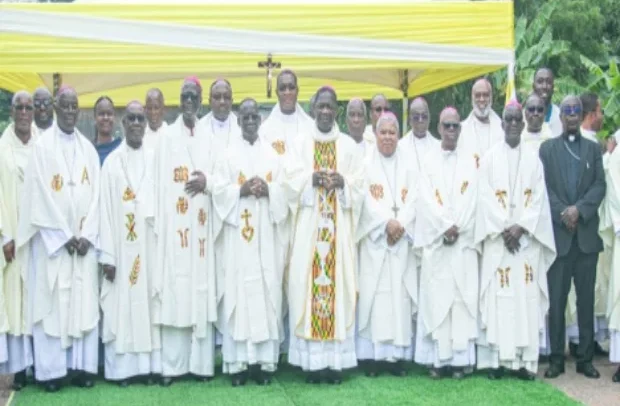
The Catholic Bishops
The Ghana Catholic Bishops’ Conference (GCBC) has called for an urgent and coordinated national crackdown on illicit drug trafficking, warning that the growing narcotics menace poses a serious threat to Ghana’s security, institutions, families and the future of the youth.
A statement signed by the President of Ghana Catholic Bishop’s Conference and Bishop of Sunyani, Most. Rev. Matthew Kwasi Gyamfi, said the seizure of nearly 3.9 tonnes of cocaine by French customs authorities at Dunkirk on September 10, 2026, with an estimated street value of €225 million, was “deeply disturbing.” The cocaine was reportedly concealed in a container of plastic waste that had arrived from Ghana, with part of the consignment allegedly destined for Antwerp, Belgium.
The Bishops noted that four Ghanaians—Desmond Koranteng Curiel, alias “Paul Kweku Yeboah” or “Biggs”; Musah Attah, alias “Kromo”; Kweku Otchere; and Jessica Hartog—had been arraigned before the High Court in Accra and remanded over alleged conspiracy to export narcotic drugs without a licence and exportation of narcotic drugs. They stressed that the accused persons remained presumed innocent until proven guilty, and urged investigations to establish how the alleged consignment passed through legitimate commercial channels.
The Conference said the Dunkirk seizure formed part of a wider pattern of drug trafficking incidents linked to Ghana, citing several major interceptions recorded since March 2025. It also referenced concerns raised in a September 18, 2026 parliamentary memorandum, including cocaine seizures at Pedu Junction, on the Takoradi-Cape Coast highway and at Tema Port, as well as alleged narcotics concealed in other consignments. According to the Bishops, the parliamentary petitioners estimate that high-profile seizures linked to Ghana over the past two years exceed $1 billion in value.
The Bishops further expressed concern over the involvement of public officials in alleged narcotics-related activities, citing the reported arrest of nine public officers in March 2026 over a large consignment of undeclared tramadol at Tema Port. They called for investigations to go beyond couriers and identify the financiers, principal traffickers and networks behind the trade, stressing that anyone who abused public trust to facilitate the movement of illicit drugs must be held accountable.
The Conference appealed to the government to strengthen collaboration among the Police Service, Narcotics Control Commission (NACOC), Customs, port authorities, the judiciary and other relevant institutions to combat the menace. It called for improved scanning and surveillance systems at Ghana’s ports, airports and borders, stronger cooperation with INTERPOL and Europol, and investigations that “follow the money” to uncover the financial networks sustaining narcotics trafficking.
The Bishops also backed Parliament’s oversight role, urging relevant ministers and state agencies to account for the adequacy of drug detection, surveillance and clearance procedures at the country’s ports and airports. They called for such proceedings to be conducted without partisan point-scoring, but with the seriousness, transparency and cooperation required to address what they described as a matter of national concern.
Beyond enforcement, the GCBC called for greater investment in drug-prevention education, rehabilitation and treatment, particularly for young people. It urged Catholic parishes, schools, youth organisations, priests, catechists and lay leaders to intensify awareness and pastoral support, while appealing to parents and guardians to maintain close relationships with their children and provide moral and emotional guidance.
The Bishop of Sunyani, Most Rev. Matthew Kwasi Gyamfi, further said the drug menace was ultimately a moral and social crisis that required collective action.
The Conference urged Ghanaians to protect the dignity and future of the youth, calling for a response that was firm and lawful while also being preventive, rehabilitative and rooted in human dignity.
FROM Daniel K. Orlando, Ho