
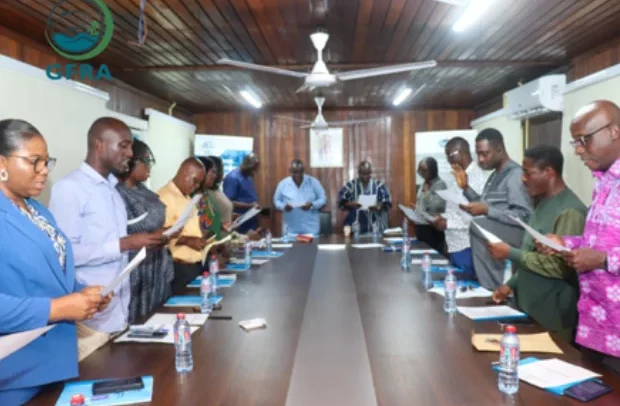
Members of the newly inaugurated FMOC were sworn in at a brief ceremony in Accra
The Governing Board of the Fisheries Commission has inaugurated two national-level fisheries co-management committees to strengthen participatory, science-based and coordinated fisheries management under Ghana’s new fisheries law.
The committees — the Scientific and Technical Committee (STC) and the Fisheries Management Operational Committee (FMOC) — were inaugurated at separate ceremonies held at the Fisheries Commission Conference Room in Accra on September 15, 2026.
The inauguration was supported by Global Fisheries and Resilience Action (GFRA) under the Inshore Exclusion Zone Enforcement and Transparency (IEZET) Project.
Executive Director of the Fisheries Commission, Professor Benjamin Campion, explained the governance arrangements under the new Fisheries and Aquaculture Act and highlighted the respective roles of the Governing Board, the Fisheries Commission and the Ministry of Fisheries and Aquaculture in Ghana’s fisheries governance framework.
Chairman of the Governing Board, Professor Wisdom Akpalu, underscored the importance of the committees in strengthening science-based, evidence-informed and participatory fisheries management.
“We are depending on you to proof test all the scientific … and technical work that will come to your committee,” he said, urging members to critically assess recommendations to support sustainable fisheries management in Ghana.
The Scientific and Technical Committee, chaired by Dr. Angela Lamptey, is mandated to provide scientific and technical advice to inform fisheries management decisions.
Under its revised mandate, its scope has been expanded to include inland fisheries and aquaculture, in addition to its existing responsibilities relating to marine fisheries.
The Fisheries Management Operational Committee, chaired by Mr. Daniel Owusu, is mandated to translate scientific and technical advice into coordinated operational action.
Its functions include the development of annual implementation plans, coordination among relevant divisions of the Fisheries Commission and other stakeholder institutions, and ensuring that institutional representation remains consistent with the requirements of the Fisheries and Aquaculture Act, 2025.
Together, the two committees are expected to strengthen the link between scientific advice and implementation, while providing structured platforms for collaboration among government institutions, technical experts and fisheries stakeholders.
A Daily Guide Report