
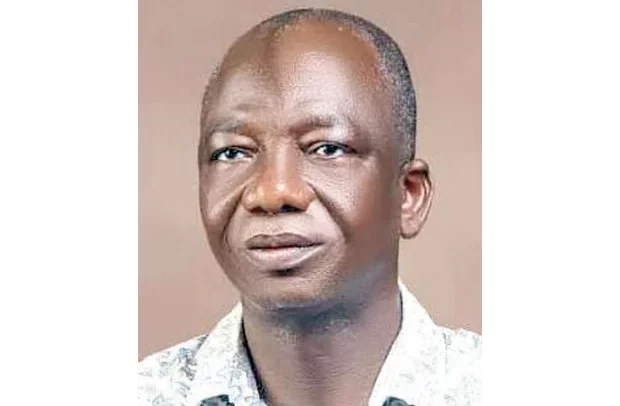
Daniel Dagbah
The Municipal Chief Executive (MCE) for Akatsi South, Daniel Dagbah, has admitted to releasing the road construction equipment for the government’s District Road Improvement Programme (DRIP) to undertake work outside the municipality.
According to the MCE, the deployment of the equipment outside the district was strictly for inter-governmental assistance and not for private commercial activities.
There has been allegations that the machines were being used for non-government purposes outside the district.
Mr. Dagbah’s response follows allegations contained in a leaked audio recording accusing the MCE of diverting DRIP equipment for purposes other than public road rehabilitation, including work allegedly connected to private individuals and properties.
According to the allegations, the machines were used at several locations to load and transport chippings and other construction materials, while payments for some of the work were allegedly collected.
A driver of one of the equipment, who was suspended by the MCE, said he was dismissed after he questioned the use of the equipment for non-public activities.
But speaking in an interview with the Daybreak newspaper, Mr. Dagbah flatly denied the allegations.
Asked whether he had suspended a driver because the driver questioned the use of DRIP equipment for his personal activities, Dagbah responded: “I would tell you it’s not true. It’s not true.”
The MCE, nonetheless, confirmed that DRIP equipment assigned to Akatsi South had been deployed to other municipalities and locations to undertake construction-related work.
He cited an ICT laboratory project at Ketu North as one of the projects for which the machines were released.
According to him, the equipment initially worked on the project for five days before returning and later being deployed again for another five-day period.
Mr. Dagbah said the arrangement was part of what he described as “inter-governmental assistance”, under which Assemblies support one another on development projects.
He further disclosed that the machines were subsequently released to assist with the construction of a health facility as a way of lobbying the financier, who is a private citizen, to also come and do same in Akatsi South.
“We released the machine again for the construction of a health facility,” he said, explaining that the project was associated with the Ketu South Municipal Assembly.
The MCE also acknowledged that the machines had been used to provide materials such as chippings, laterite and white sand, adding, “We are not using DRIP machines for private work.”
Mr. Dagbah maintained that the activities did not amount to the commercial use of government equipment.
He explained that DRIP operators were not paid directly for the work and that arrangements were made for beneficiaries of the assistance to provide fuel and other support.
According to him, beneficiaries were required to pay about GH¢500 for the operators when the machines were deployed and refill the fuel tanks before the equipment returned to the Assembly.
He also said one beneficiary repaired the air-conditioning system of a machine and purchased two new tyres for it.
However, Dagbah complained that the driver whom he had suspended had not returned the tyres to the Assembly.
The allegations also claim that DRIP machinery was seen at several locations, including properties associated with Dagbah and his family.
When asked about claims that the equipment had been used at his father’s property, the MCE rejected the claim.
“It’s my village. It’s not my father’s,” he said, arguing that there was no law preventing a public official from using resources or vehicles for activities outside government work as long as public funds were not being used improperly.
He also pointed to his personal use of his private vehicle for government activities as an example of what he described as cooperation between public and private resources.
The controversy comes at a time when the management and use of DRIP equipment are attracting increasing public attention.
The District Road Improvement Programme was launched in 2024 with the deployment of heavy-duty road construction machinery to Metropolitan, Municipal and District Assemblies (MMDAs) to support local road rehabilitation and other development needs.
National DRIP Coordinator, Edwin Nii Lantey Vanderpuye, has repeatedly warned Metropolitan, Municipal and District Chief Executives (MMDCEs) against using the equipment for private purposes, stressing that the machines are national assets entrusted to assemblies for public development.
He has also disclosed that the programme’s tracking system had detected cases of misuse, resulting in the demobilisation of some machines.
A Daily Guide Report