
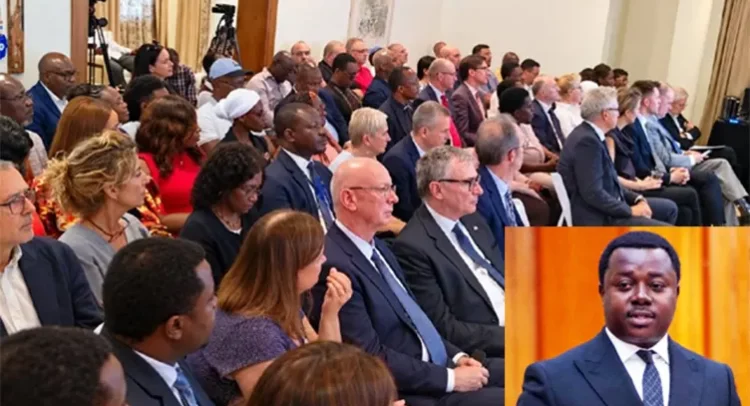
Section of dignitaries at the event. INSET: Rev. John Ntim Fordjour
The Ranking Member of Parliament’s Defence and Interior Committee, Rev. John Ntim Fordjour, has warned that Ghana should not be comfortable with intelligence assessments that suggest the country is unlikely to suffer terrorist attacks.
According to him, no country is immune to terrorist attacks and Ghana must remain on high alert, especially given its 590-kilometre porous border with Burkina Faso.
The Assin South Member of Parliament (MP) made the call at a Symposium on Terror in the Middle East and Africa held under the theme: “Terror in the Middle East and Africa: Shared Challenges, Shared Responses.”
“We should not discount any signal. We should not get comfortable with assessments that seem to preclude us from attack. No country is beyond attack,” he cautioned.
Mr. Fordjour said lessons from the October 7 massacre in Israel, where over 1,200 people were killed and over 250 taken hostage despite Israel’s sophisticated intelligence apparatus, should put Ghana on an alert status.
He noted that terrorism continues to claim thousands of lives across Sub-Saharan Africa, citing the 2016 Grand Bassam attack in Ivory Coast, the February 14 attack in Katiola in Burkina Faso where eight Ghanaian traders were killed, and over 10,000 deaths from over 3,026 attacks by the JNIM group alone within the Sahel.
The MP said Ghana faces a unique challenge due to its northern frontier, warning that assessments show terrorist groups could have access to Ghanaian citizens through porous routes if they intend to attack.
“We share over 590-kilometre northern border with Burkina Faso, and I cannot say that the border is foolproof. Other assessments have it that the JNIM group actually does have access if they want, as and when they want, through some of the porous routes,” he stated.
He acknowledged that successive governments have built strong kinetic and non-kinetic systems for terrorism prevention, but stressed that Ghana cannot stay resilient in isolation. “Joint intelligence sharing is one very critical factor. We all understand how our multilateral and regional security sharing at some point was strained, and we’re striving to get it back to the optimal level,” he said, calling for revived diplomatic engagement with Sahel neighbours.
Mr. Fordjour also referenced recent data collected by CDD-Ghana which surveyed 17 districts on vulnerability to violent extremism. According to him, the findings show that it is not necessarily poverty, but the desire to have more money that makes violent extremism attractive to some youth in certain districts — a trend he described as “not very comfortable” for Ghana.
“Ghana cannot be comfortable, but we have to continue to collaborate, both multilateral, bilateral, regional, sub-regional, joint intelligence sharing, so that we will not be surprised,” he emphasised, urging the country to strengthen early warning systems and response mechanisms.
The Israeli Ambassador to Ghana, Roey Gilad, who also spoke at the symposium commemorating the third anniversary of the October 7 attack, said the trauma of the massacre still lives with Israelis, and challenged the basic belief that the Jewish state is the ultimate guarantee for the security of the Jewish people.
“Every Israeli remembers very well where he or she was on October 7, 2023, at 6:29 a.m., just as every American remembers where he or she was on September 11, 2001. Israel after the October 7 massacre is not the same country,” Ambassador Gilad said.
He noted that Israel is no longer naive but stronger, adding that the proverb “He who wants peace should be ready for war” has never been truer.
He thanked Ghana for its contribution to Israel’s security through the Ghanaian battalion serving with UNIFIL along the Israeli-Lebanese border.
BY Prince Fiifi Yorke