
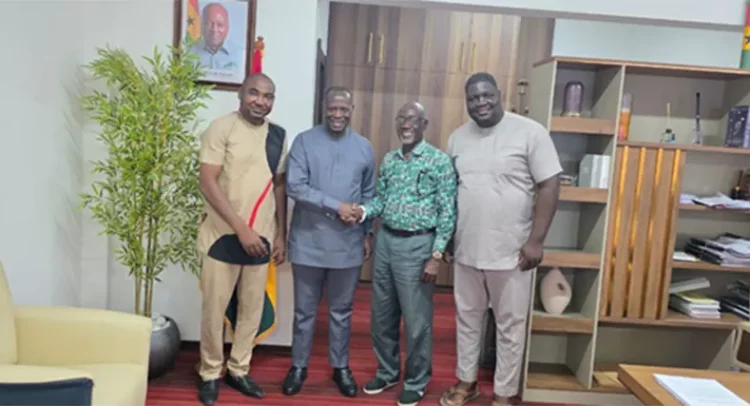
The IFEJ delegation and Armah-Kofi Buah (2nd L)
The Institute of Financial and Economic Journalists (IFEJ) and the Ministry of Lands and Natural Resources have agreed to work towards a formal partnership to improve specialised reporting on mining, forestry and land reform in Ghana.
The agreement followed a courtesy call on the Minister for Lands and Natural Resources, Emmanuel Armah-Kofi Buah, in Accra by an IFEJ delegation led by its President, Roger Agambire Agana. The other members were Bernard Yaw Ashiadey and Rayborn Bullay.
Mr. Agana asked the ministry to support training programmes and technical briefings for journalists, saying IFEJ was ready to help explain government policies to the public and prepare communities for the drive towards local value addition in the minerals sector.
Mr. Ashiadey proposed a memorandum of understanding (MoU), an annual conference on mining and natural resource governance, and joint research and publications with technical input from the ministry.
He also called for closer engagement with the ministry’s agencies and visits by IFEJ members to degraded lands undergoing reclamation to enable journalists to report on both the damage caused and recovery efforts.
Mr. Buah welcomed the proposals and agreed to organise a half-day workshop at which he and heads of the ministry’s agencies would brief IFEJ members on sector policies and reforms.
He said general media coverage often failed to capture the substance of policies in the sector, making specialised reporting necessary to improve public understanding.
The minister outlined several reforms, including a new mining policy approved by Cabinet to replace the 2014 policy and a mining law before Parliament that would require mining companies to sign community mining agreements.
Under the proposed arrangements, companies would commit in writing to development priorities identified by host communities, including schools, roads and training, over the life of a mine.
“It’s not a charity. It’s not corporate social responsibility,” he said, emphasising the distinction between the proposed agreements and voluntary corporate social responsibility initiatives.
Mr. Buah said the reforms would reduce mining lease terms from 30 years to 20 years, after which the state would decide whether to renew them or introduce Ghanaian partners.
He added that holders of reconnaissance licences who failed to demonstrate expenditure on exploration after five years would lose their licences.
A new medium-scale mining category would also provide a pathway for Ghanaian small-scale operators to expand their businesses.
On forestry, the minister said 44 forest reserves had been destroyed in recent years, leaving an estimated area of degraded land equivalent to about 13,000 football fields.
He said the state had regained full control of the affected reserves, while the ministry’s Tree for Life initiative was supporting reclamation and replanting efforts.
The initiative involves schoolchildren and attracts private-sector support to help bridge funding gaps, he said.
Mr. Buah also highlighted the use of technology to reform land administration and improve access to land services.
A Business Desk Report