
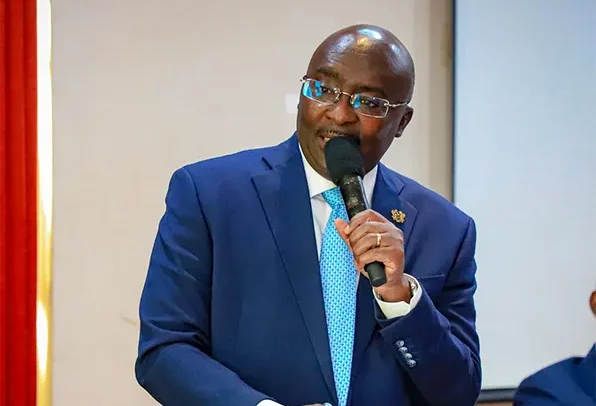
Dr. Mahamudu Bawumia
Flagbearer of the opposition New Patriotic Party (NPP), Dr. Mahamudu Bawumia, has said economic stability is meaningless if it does not translate into improved living conditions for Ghanaians, accusing the government of failing to ensure that falling inflation and exchange rates benefit ordinary citizens.
He said the real measure of economic performance should be the impact of government policies on the pockets of the people rather than statistical improvements in key economic indicators.
Speaking at a thanksgiving service at the F.D. Walker Memorial Temple of the Church of Pentecost in Sunyani to thank God for the successful National Delegates Conference of the NPP, the former Vice President said the government’s claims of economic recovery must be matched by improvements in the living conditions of the population.
He described the situation as a “tale of two economies”, comprising what he called the paper economy, reflected in statistics such as inflation and exchange rates, and the pocket economy, which represents the daily experiences of ordinary Ghanaians.
“The pocket economy is the one Ghanaians are interested in. Our living conditions matter most to us,” he said.
“Stability is enviable but not the goal or an end in itself. Stability is the way of improving the lives of the people. It is a means to an end. What is the benefit of the stability they are talking about?” he asked rhetorically.
Dr. Bawumia questioned whether cocoa and cashew farmers had benefited from the economic stability being touted by the government, citing the promise of GH¢6,000 per bag of cocoa.
He also pointed to rising rents and other living costs, arguing that economic indicators alone could not adequately reflect the hardships confronting households.
He said the government must demonstrate how its economic policies were improving incomes and easing the burden on ordinary citizens.
2028 Promise
Dr. Bawumia also pledged that the NPP would approach the 2028 general election with practical, workable and costed policies, saying the party had learnt lessons from its defeat in the 2024 elections.
He said the party had reflected on the outcome of the election and identified mistakes that needed to be corrected before the next polls.
“I have been given the flag of the NPP again, by God’s grace, so when we become successful in 2028 we know what to do to correct the mistakes of the past,” he said.
He cautioned political parties against making promises they could not fulfil merely to win elections, saying voters would eventually hold them accountable.
“Promises made to win power must be promises we can keep, because time tests every promise,” he said.
According to him, the widespread use of social media meant that politicians could no longer easily escape scrutiny over unfulfilled campaign pledges.
“When you come to power and you fail to fulfil your promise, Ghanaians will play the ‘a few moments later’ for you,” he stated.
Dr. Bawumia accused the governing National Democratic Congress (NDC) of failing to fulfil some of its campaign promises, particularly the proposed 24-Hour Economy.
He questioned why the policy had yet to materialise nearly two years after the party assumed office, adding that the government appeared not to have understood what it was promising Ghanaians.
He also questioned the implementation of the Agenda 111 hospital project, asking whether the government had completed the projects as promised.
Free Speech
The former Vice President further accused the government of presiding over an environment in which freedom of expression was under threat.
He asserted that people who criticised the government on radio or the internet risked arrest, describing the situation as an era of “arrest him” and “arrest her”.
He said democracy should guarantee citizens the freedom to express their views without intimidation.
Dr. Bawumia, however, called for peace and unity across the country, stressing the need for Ghanaians to rise above ethnic, religious and tribal differences.
He praised Ghana’s religious tolerance, noting that Muslims and Christians were able to worship together and participate in each other’s religious gatherings.
He cited his presence at the Church of Pentecost service as an example of the peaceful coexistence between the country’s religious communities.
Dr. Bawumia said the NPP’s desire to return to power was driven by its commitment to serve the people rather than intimidate or dominate them.
He said a future NPP government would focus on improving the lives of the poor, vulnerable and ordinary citizens.
“We want to come and serve the people of Ghana and not to lord over the people of Ghana,” he pointed out.
He also prayed for God to grant the party’s elected executives, from the polling station to the national level, the strength to work harder for the party, and for the country to have a government that would govern in the interest of its people.
By Ernest Kofi Adu