
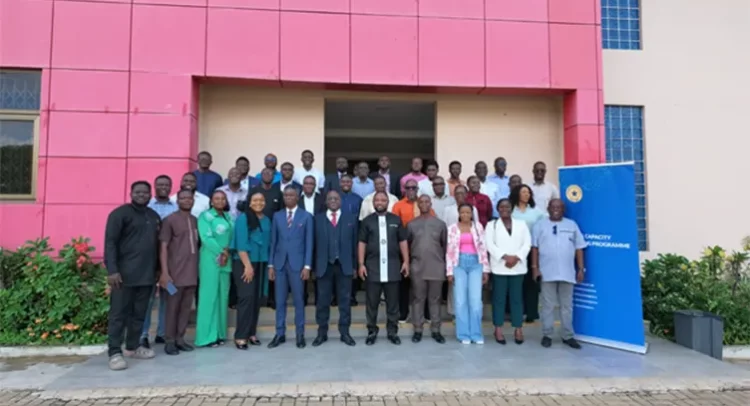
Bernard Otabil (M) with participants
The Director of Communications at the Bank of Ghana (BoG), Bernard Otabil, has urged journalists to uphold accuracy, balance and ethical standards in financial reporting to combat misinformation and protect public confidence.
Speaking at a three-day training workshop for journalists in Koforidua, he said misleading headlines about inflation, exchange rates and monetary policy could trigger panic, fuel speculation and negatively affect households and businesses.
“The ethics of financial journalism matters because in finance, words move markets. A misleading headline on inflation, exchange rates or the policy rates can create panic, fuel speculation and hurt the very households and businesses we are trying to protect,” he said.
Mr. Otabil said accurate reporting was essential to helping the public understand the Bank of Ghana’s policies and make informed economic decisions.
“The public may not read our MPC reports, but they read your headlines and listen to your reports to make economic decisions. Accuracy, therefore, is not just a potential venture, it is an economic asset,” he stated.
He said reporting on monetary policy and the central bank’s operations would be more effective if journalists understood the issues and communicated them accurately to the public.
Mr. Otabil said the workshop formed part of the central bank’s efforts to strengthen its engagement with the media and improve public understanding of monetary policy and its other operations.
He explained that integrating Monetary Policy Committee (MPC) statements with individual members’ submissions was part of a major reform introduced by the bank to promote transparency.
The Director of Communications also cautioned journalists against the growing threat of misinformation and disinformation, particularly content spread through digital platforms and artificial intelligence.
He said the rapid spread of market rumours and coordinated disinformation campaigns targeting currencies had become a global concern requiring responsible reporting and stronger verification practices.
“This is a global phenomenon driven by technology and the speed of digital platforms, and it has undermined public trust everywhere. That is why credibility has become journalism’s most valuable asset,” he added.
He urged journalists to prioritise verification, maintain balance and provide clarity in their reports, noting that adherence to ethical standards would help protect public savings and promote confidence in the financial system.
Mr. Otabil stated that the central bank would continue to strengthen its partnership with the media through expanded training programmes, editors’ forums and dedicated communication platforms.
The training would cover the ethics of financial reporting, the Bank of Ghana’s mandate and regulatory framework, and the complexities of central bank balance sheets.
Participants would also be taken through the bank’s domestic gold purchase programme, developments in the foreign exchange market, inflation dynamics, and ways of integrating MPC statements with individual members’ submissions.
By Ebenezer K. Amponsah