
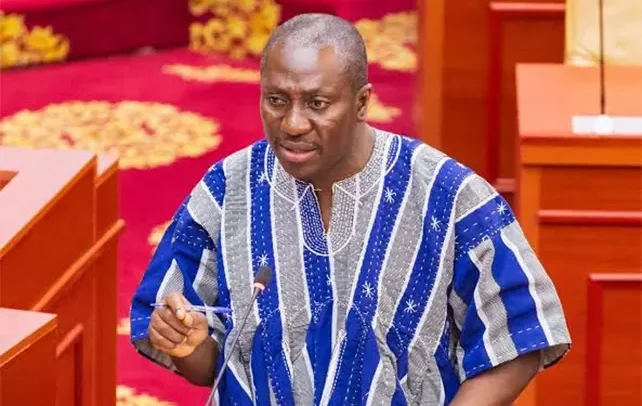
Alexander Afenyo-Markin
The Minority Leader in Parliament, Alexander Afenyo-Markin, has called for stronger enforcement mechanisms to ensure the recovery of public funds lost through financial irregularities and the punishment of public officials found culpable.
He said it was no longer enough for public institutions to identify financial irregularities, expose weaknesses in public expenditure or report instances of financial misconduct without taking concrete steps to address them.
Addressing the opening of the African Organisation of Public Accounts Committees (AFROPAC) Conference and General Meeting in Accra, he challenged African governments and accountability institutions to ensure that audit findings translated into corrective action, recovery of public funds and appropriate sanctions.
He said the effectiveness of Public Accounts Committees (PACs) should be measured not by the number of public officials summoned before them or the volume of audit queries examined, but by the actions taken to address the irregularities uncovered.
“Year after year, audit reports bring to light irregular expenditures, unsupported payments, weaknesses in procurement, failures in revenue collection, and deficiencies in the management of public assets,” he stated.
He observed that although parliamentary committees examined the findings, summoned public officials and made recommendations, questions remained about whether the irregularities had been corrected, public funds recovered and those responsible sanctioned.
“More importantly, have the institutional weaknesses that permitted these failures been addressed?” he asked.
The Minority Leader insisted that African countries could not continue to audit the same financial failures year after year without holding anyone accountable.
Mr. Afenyo-Markin, therefore, called for a shift from merely identifying financial irregularities to strengthening the capacity of oversight institutions to prevent misconduct, pursue corrective action and secure the recovery of public funds.
He proposed the introduction of statutory mechanisms to track and enforce audit recommendations, insisting that parliamentary investigations must produce tangible results.
According to him, the changing financial landscape, characterised by digital public financial management systems, complex public-private partnerships, sovereign debt instruments and sophisticated cross-border financial transactions, required more effective oversight mechanisms.
He proposed five structural reforms to strengthen Public Accounts Committees across Africa.
These include institutionalising real-time and concurrent oversight, equipping committee secretariats with forensic and digital technical expertise, ensuring statutory tracking and mandatory enforcement of audit recommendations, expanding scrutiny of sovereign debt management and illicit financial flows, and promoting inter-parliamentary intelligence sharing.
He also called for stronger collaboration between parliamentary committees and national audit institutions to improve the monitoring and implementation of audit recommendations.
The Minority Leader said the consequences of weak financial accountability extended beyond figures contained in audit reports, affecting the delivery of essential public services.
He cited hospitals without essential equipment, schools lacking adequate infrastructure and communities deprived of public services for which resources had already been appropriated.
Mr. Afenyo-Markin said ordinary citizens ultimately bore the burden of financial mismanagement through inadequate public services and limited development opportunities.
He further urged both the Majority and Minority sides of African parliaments to approach public financial accountability as a constitutional responsibility rather than a partisan political exercise.
“Public financial accountability must never become a principle that we defend only when we occupy the opposition benches and conveniently disregard when entrusted with government power,” he said.
He stressed that the Majority must recognise parliamentary scrutiny as an essential part of democratic governance, while the Minority must exercise its oversight responsibilities with diligence, fairness and fidelity to the evidence.
The Minority Leader maintained that the responsibility to protect public resources must remain constant, regardless of the political party in power.
By Ernest Kofi Adu