
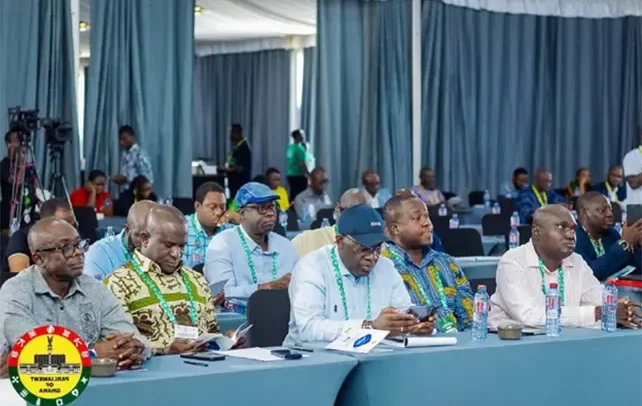
Cross section of MPs at the event
The Speaker of Parliament, Alban Sumana Kingsford Bagbin, has cautioned Members of Parliament (MPs) against rushing legislation through Parliament, citing recent instances in which bills had to be recalled for further consideration after inconsistencies were discovered following their passage.
Speaking at the opening of the Parliamentary Training Institute’s (PTI) Annual Parliamentary Committee Leadership Development Programme in Accra, the Speaker said the quality of legislative scrutiny must be a top priority for Parliament.
“I talked about the quality of legislative scrutiny. Well, this Parliament had to recall about four bills that it passed to take them through the second consideration stage again. It doesn’t speak well of Parliament,” he said.
Mr. Bagbin warned that MPs, rather than those pressuring them to expedite legislation, would ultimately be held responsible for the passage of flawed laws.
“So please, members, don’t allow anybody to push you to rush legislation. For that person will never be held responsible for the passage of bad laws. It’s you that will be held responsible, and you know how your constituents can judge you,” he stressed.
He explained that the effectiveness of Parliament did not depend merely on the powers conferred on it by the Constitution but also on the competence, integrity and commitment with which those powers were exercised.
According to him, parliamentary strength could not be measured solely by the volume of legislation enacted or the intensity of debates in the chamber.
“It must be demonstrated through the quality of legislative scrutiny, the effectiveness of oversight, the responsiveness of representation, and the confidence that citizens repose in the institution,” he said.
Bills Recalled
One of the bills that has been earmarked for further consideration is the Human Sexual Rights and Family Values Bill, 2025, which Speaker Bagbin announced would return to Parliament for a second consideration to address errors identified after its initial passage.
Originally introduced as a private member’s bill by the MP for Assin South, Reverend John Ntim Fordjour, and his co-sponsors, the legislation seeks to criminalise LGBTQ+ activities and advocacy while reinforcing traditional, cultural and religious family values.
Mr. Bagbin said the bill would undergo a thorough second consideration process and further refinement during Parliament’s upcoming sittings.
The Ghana Investment Promotion Authority (GIPA) Bill, 2025, was also recalled after inconsistencies and errors were identified following its passage.
The bill, which was passed in March/June 2026, seeks to replace the Ghana Investment Promotion Centre (GIPC) Act, 2013.
The Speaker maintained that Parliament retained the authority to revisit and rescind a bill, including through a motion of rescission, even after it had passed the third reading stage.
He reminded MPs that under the 1992 Constitution, Parliament was entrusted with fundamental responsibilities relating to legislation, representation, financial control and oversight.
He said although the chamber remained the most visible expression of parliamentary authority, much of Parliament’s substantive work took place within its committees.
He urged committee leaders to take their responsibilities seriously, build consensus and ensure that laws passed by Parliament could withstand public scrutiny.
“A parliament with weak committees cannot be an effective parliament. Equally, strong committees cannot exist without purposeful and competent leadership,” he stressed.
Parliament’s Oversight
A former Majority Leader of Parliament, Osei Kyei-Mensah-Bonsu, also lamented Parliament’s failure to fully discharge its oversight responsibilities over the years, particularly in relation to the Bank of Ghana (BoG).
Mr. Kyei-Mensah-Bonsu said Parliament had a clear constitutional duty to establish committees to investigate infractions involving the central bank.
The former Majority Leader also criticised the conduct of the Auditor-General, saying the practice of leaking audit reports before they were formally submitted to Parliament undermined individuals cited in the reports and weakened the institution’s work.
He stressed that the Auditor-General’s work was not complete until Parliament had considered and dealt with the report.
“The Auditor-General should know that not until you submit your report to Parliament and Parliament deals with it, your work is not finished. That is why elsewhere the Auditor-General is referred to as Parliament’s Auditor-General, or the Parliamentary Auditor-General. You don’t exist on your own. You are a tool for Parliament in the performance of their oversight responsibilities,” he said.
Mr. Kyei-Mensah-Bonsu warned that the premature publication of audit findings could destroy reputations before individuals cited in the reports had the opportunity to respond to the allegations before Parliament.
“You let people tear the image of people into shreds. The report comes to Parliament. Parliament invites you, and you admit your mistakes and you are pleading for forgiveness. What have you done to that person? he questioned.
He told participants that significant challenges continued to undermine parliamentary oversight, and urged them to confront those challenges to strengthen Parliament’s effectiveness.
By Prince Fiifi Yorke