
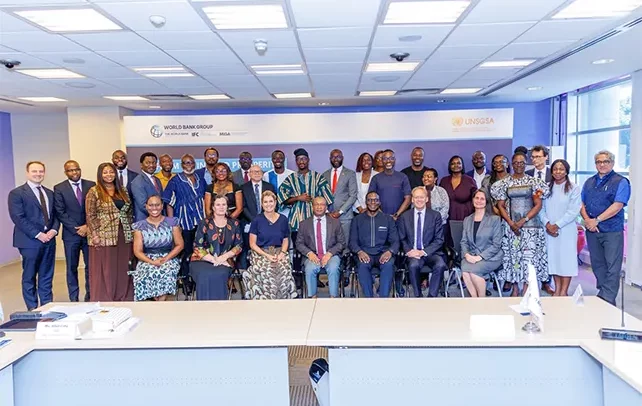
Her Majesty Queen Máxima of the Netherlands and other stakeholders at the Roundtable discussion
The World Bank Group has convened Her Majesty Queen Máxima of the Netherlands, the United Nations Secretary-General’s Special Advocate for Financial Health (UNSGSA), alongside senior representatives of government, regulatory institutions and the financial sector for a high-level roundtable on expanding savings opportunities, pension coverage and access to capital markets for informal-sector workers.
Held at the World Bank Group’s Accra office under the theme “From Savings to Prosperity: Informal-Sector Pensions, Financial Health, and Capital Markets”, the roundtable, organised jointly by the World Bank and the International Finance Corporation (IFC), explored practical approaches to strengthening household financial resilience while mobilising domestic savings for productive investment.
The engagement forms part of broader efforts to advance financial inclusion beyond access to financial services, towards enabling individuals and households to build savings, manage financial risks and secure their long-term financial wellbeing.
Queen Máxima highlighted the importance of integrating savings, insurance, pensions and other financial services to help individuals move beyond account ownership towards greater financial security. “Financial access is a critical enabler, but we must also look at savings, insurance, pensions, and broader financial resilience,” she said.
She emphasised that emergency savings are particularly important in sustaining long-term retirement contributions, noting that immediate financial pressures often make it difficult for households to prioritise future needs.
“It is difficult to focus on retirement 30 years from now if you are worried about a financial emergency tomorrow,” Queen Máxima said. She also underscored the commercial relevance of financial health, describing it as a business imperative rather than simply a corporate social responsibility concern.
Nathalie Kouassi-Akon, IFC Division Director for West Africa Gulf of Guinea, said the roundtable provided an opportunity to build on Ghana’s progress in expanding financial access and strengthening its financial system, while addressing the remaining gaps in household financial security.
“Financial inclusion, while essential, is not the finish line. The real measure of success is whether people are able to build resilience, withstand shocks and improve their financial wellbeing over time,” she said.
She said Queen Máxima’s engagement came at an important time as the World Bank Group advanced its Country Partnership Framework for Ghana, providing an opportunity to align ongoing development efforts with the country’s evolving financial sector priorities.
“Our hope is that this conversation will lead not only to valuable insights, but also to practical actions and partnerships that help more Ghanaians move from financial vulnerability to financial security, and from savings to prosperity,” she said.
The roundtable identified several priorities for advancing financial health and expanding savings opportunities among underserved populations.
These include developing affordable and flexible financial products that accommodate irregular incomes; expanding digital platforms that reduce the cost and complexity of saving and investing; and strengthening consumer protection, transparency and trust across financial services.
Participants also emphasised the need for safe and regulated channels through which long-term savings can be mobilised for productive investment, supported by a broader range of credible investment opportunities.
A Business Desk Report