
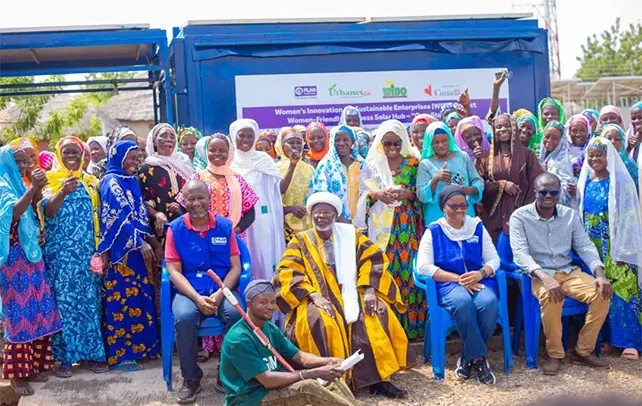
Hajia Muniratu Issifu and Chief of Voggu in a pose with some beneficiaries
Plan International Ghana has handed over a women-friendly solar hub to women in the Kumbungu and Tolon districts at Voggu in the Northern Region under the Women’s Innovation for Sustainable Enterprises (WISE) Project.
The project is implemented by Plan International Ghana and Plan International Canada, in partnership with WIDO and Urbanet, with funding from Global Affairs Canada.
The project is expected to benefit about 60 communities in Kumbungu, Tolon and other districts.
Speaking at the handover ceremony, Plan International Ghana Country Director, Hajia Muniratu Issifu, said the project was implemented between January 2020 and March 2025 in 150 communities across five districts. It aimed to address barriers that prevent women from fully participating in economic activities and building sustainable livelihoods.
“We understood that empowering women requires more than business training or access to financial services. It requires creating an enabling environment where women can access information, build confidence, connect with opportunities, make informed decisions and grow their businesses,” she stated.
Madam Issifu said the project’s gender-transformative approach involved working with women entrepreneurs, engaging men and community leaders as allies, improving access to financial and business services, and supporting women to build networks that contribute to their economic advancement.
“The results have been encouraging. The Women and Girls Empowerment Index increased by 11.2 per cent, while the likelihood of participating households living below the poverty line decreased by 10.5 per cent. These results reflect meaningful progress towards improving women’s economic participation and the well-being of their households,” she added.
Madam Issifu noted that women, particularly those in rural communities, often lack easy access to the information, services and networks that could help their businesses grow.
“Sometimes, the challenge is not a lack of ideas or determination, but the distance between women and the opportunities available to them,” she stressed.
The Plan International Ghana Country Director explained that the solar hub is intended to provide a community-based space where women entrepreneurs can access business development services, market information, digital platforms and referral support.
“Its true value will not be measured by the building or the solar equipment alone. It will be measured by the women who use it, the businesses that grow through the services available here, the connections that are built, and the opportunities that become accessible to more women in this community,” she pointed out.
She urged traditional leaders, community representatives and women entrepreneurs to take collective ownership of the facility and ensure it remains welcoming and accessible, particularly to women and young people seeking support to develop their ideas and strengthen their livelihoods.
Mr. Basit Jibreel of Urbanet assured Plan International Ghana and its partners that the organisation was committed to managing and maintaining the facility on behalf of the women.
“We believe this arrangement will bring the equipment closer to the communities and make access to these services easier,” he said.
The Chief of Voggu, Sulemana Saaka, thanked Plan International Ghana and its partners for providing the solar hub, and urged beneficiaries to make good use of it.
“I strongly believe the facility will greatly benefit the people of Kumbungu and Tolon. When you get a facility like this, cherish it and put it to good use so that people in both districts can benefit immensely from it,” he said.
The leader of the women’s group, Eliasu Nafisah, said the hub would help women strengthen their businesses by giving them access to equipment and other support.
“Our colleagues used to go for kayaye because women here did not have access to business opportunities. With the support of Plan International Ghana and its partners, we now have a say in our homes as wives because we can contribute to their development. We are also financially stable enough to take care of ourselves and our children’s education,” she stated.
FROM Eric Kombat, Voggu