
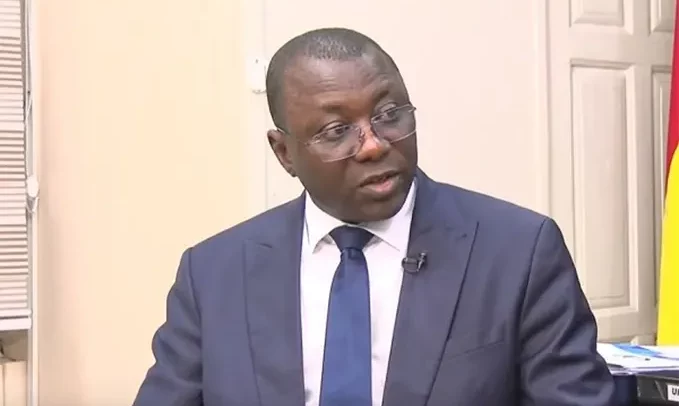
Dr. Mohammed Amin Adam
The Minority in Parliament has accused the Mahama-led government of increasing the financial burden on Ghanaians despite its claim that the 2027 Budget introduces no new taxes.
According to the Minority, the government is relying on significant increases in existing taxes, fees and charges to raise revenue, a development it says contradicts the Finance Minister’s assurance that no additional tax burden is being imposed on the public.
Addressing a press conference in Parliament after the budget reading, the Ranking Member of Parliament’s Finance Committee, Dr. Mohammed Amin Adam, said the 2027 Budget projected a substantial increase in revenue from domestic taxes and administrative charges, which would ultimately be borne by households and businesses.
He cited the projected increase in fees and charges from GH¢1.3 billion in 2026 to GH¢6.1 billion in 2027, representing an increase of 354 percent.
Dr. Amin Adam said the development was particularly worrying because the government had already laid a new Fees and Charges Bill before Parliament for approval.
“Every passport, licence, permit and registration is a charge on the pocket,” he said, arguing that the increases would impose additional costs on ordinary Ghanaians.
He further disclosed that taxes on domestic goods and services were projected to increase from GH¢77.3 billion in 2026 to GH¢94.9 billion in 2027, representing a 22.8 percent increase.
He added that Value Added Tax (VAT) collections are expected to rise by 18.2 percent, from GH¢50.7 billion to GH¢59.9 billion, while excise duties are projected to increase by 23 percent, from GH¢8.5 billion to GH¢10.5 billion.
The Communications Service Tax is also expected to rise by 38.7 percent, from GH¢1.5 billion to GH¢2.1 billion.
The Minority expressed concern about the projected increases in the National Health Insurance Levy (NHIL) and the Ghana Education Trust Fund (GETFund) Levy, which are each expected to increase by 38 percent.
Dr. Amin Adam questioned why the two levies were projected to record such substantial increases when VAT on a broadly similar tax base was expected to grow by only 18 percent.
He also questioned the projected growth in Pay-As-You-Earn (PAYE) collections, which are expected to increase by 15.6 percent in 2027, compared with a projected 13.8 percent increase in the government’s wage bill.
For 2028, PAYE collections are projected to increase by another 21.5 percent, while the wage bill is expected to grow by 13 percent.
The Ranking Member argued that the figures raised questions about the source of the additional revenue, particularly when the Budget did not provide sufficient incentives to stimulate private sector expansion and employment.
He also warned that the new personal income tax bands introduced this year could result in additional financial pressure on workers when they take full effect in 2027.
Although the lower tax band provides relief of approximately GH¢11 a month to low-income earners, he said the projected inflation rate of eight percent in 2027 would erode that benefit.
He explained that a worker earning GH¢2,000 monthly could lose approximately GH¢50 in purchasing power over a year if inflation increased from the current 5.5 percent to the projected eight percent.
Workers earning between GH¢3,800 and GH¢20,000 monthly, he added, would pay an additional GH¢6 monthly, while those earning above GH¢20,000 would pay an additional GH¢17.
The Minority further questioned discrepancies between the revenue projections contained in the 2027 Budget and those in the government’s Fiscal Policy Strategy.
It said taxes on goods and services were projected at GH¢101.5 billion for 2027 in the Fiscal Strategy, but the Budget subsequently reduced the figure to GH¢94.9 billion.
For 2028, the difference was even greater, with the Fiscal Strategy projecting GH¢131.4 billion compared with GH¢105.1 billion in the Budget.
Dr. Amin Adam called on the Finance Minister to provide further explanations for the discrepancies.
The Minority also raised concerns about limited credit available to the private sector, arguing that government borrowing of GH¢59 billion from commercial banks in 2027 could further constrain businesses seeking financing.
It said the projected increases in taxes and charges, coupled with limited access to credit, could undermine the ability of traders, farmers and small manufacturers to expand their operations.
The Minority maintained that the government’s claim of introducing no new taxes should not obscure the additional financial obligations facing Ghanaians under the 2027 Budget.
By Ernest Kofi Adu, Parliament House