
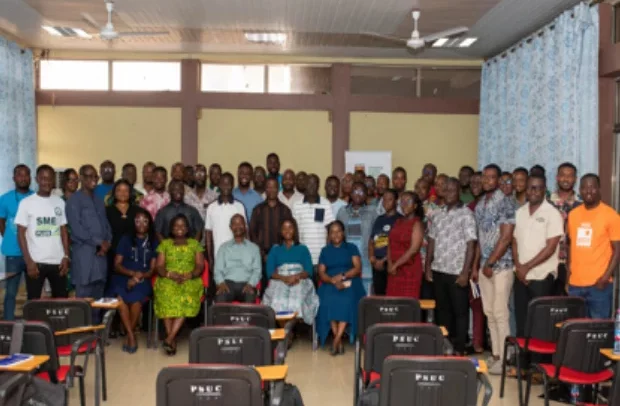
Participants at the event
Efforts to strengthen access to appropriate financing for businesses across Ghana received further support as the Ghana Investment Support Programme (GhISP) and Chartered Institute of Bankers, Ghana (CIB Ghana) extended their financial institutions capacity-building initiative to Kumasi.
The two-day workshop, held at the Public Service Workers Union Conference Centre, TUC, provided a platform for financial sector professionals to examine practical approaches for improving SME lending while strengthening financial inclusion and sustainability.
The workshop brought together professionals from banks, financial NGOs and community banks serving SMEs across Ghana’s regional economies. Participants shared perspectives on the financing needs and challenges of businesses operating in different markets and explored practical approaches for expanding access to appropriate financing for SMEs.
According to British International Investment (BII) Country Director, Kwabena Asante-Poku, the workshop also highlights GhISP’s efforts to step up its support to Ghana’s financial institutions through the organisation’s technical assistance offering.
“GhISP has already demonstrated its ability to strengthen SME investment readiness through company-level technical assistance.
“Now, we are taking lessons from this work, combined with insights from BII’s technical assistance partnerships with financial institutions in the region and our wider ecosystem work, and applying this to tailoring support to Ghanaian financial institutions. Our partnership with CIB to deliver these workshops marks the beginning of an exciting chapter,” he said.
In a message conveyed on his behalf, the Chief Executive Officer of Chartered Institute of Bankers, Ghana, Robert Dzato, FCIB, underscored the importance of strengthening the capacity of financial institutions to respond effectively to the financing needs of SMEs.
The message highlighted CIB Ghana’s commitment to equipping banking professionals with practical skills in credit assessment, inclusive lending and sustainable finance, while emphasising the importance of translating knowledge gained from the workshop into improved lending practices that support SME growth across Ghana.
Participants in the Kumasi workshop examined how financial institutions can better understand the realities of SMEs operating within different markets and design financing solutions that respond to their business models, cash-flow patterns and growth potential.
Particular attention was given to strengthening credit assessment practices, cash-flow-based lending, climate-responsive financing and gender-smart approaches to SME finance. Participants also considered how inclusive financial products can help viable but underserved enterprises gain improved access to formal financing.
The workshop facilitators emphasised the importance of moving beyond conventional collateral-based lending towards a more comprehensive assessment of SME business performance and repayment capacity.
Discussions highlighted how a better understanding of cash-flow patterns, business models and sector-specific risks can enable financial institutions to make more informed lending decisions while expanding access to financing for viable SMEs.
The practical nature of the workshop was reflected in participants’ discussions on how the lessons could be applied within their respective institutions.
Participants were further encouraged to develop institutional action points that could be implemented after the workshop, ensuring that the programme translates into changes in lending practices rather than ending with classroom learning.
The Kumasi workshop marked the second of the two national ecosystem engagements being implemented under the GhISP–CIB Ghana partnership and reinforced the partners’ commitment to building a financial ecosystem capable of supporting SMEs through inclusive, gender-responsive and climate-conscious financing solutions.
A Business Desk Report