
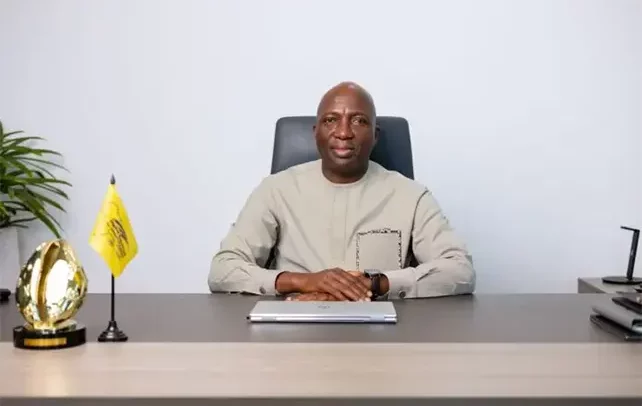
Shaibu Haruna
Chief Executive Officer of MobileMoney FinTech Limited (MMFL), Shaibu Haruna, has cautioned against celebrating Ghana’s progress on financial access, warning that deep pockets of exclusion still remain.
Speaking at The Invest Ghana programme, Mr. Haruna said Ghana has done a great job in driving access, but the country must be “very cautious” about claims that access has been achieved.
“When the Governor was addressing us, he touched on the question of access, which we’ve done a great job in Ghana in driving. But I always want us to be very cautious around that statement around achieving access because we have a lot of pockets of exclusion,” he said.
He cited the example of an old lady in the village, noting that rural access, functional literacy around the use of digital tools, regional differences, and access for differently-abled people remain major challenges.
“We still have element of rural access, and then also functional literacy around the use of digital tools, and of course there are also particular regional differences if you look deeper into the data, and of course, differently abled people. Are we taking care of people who are blind and a few other elements? So there are deeper elements that need to be solved from a customer access point of view,” he added.
Mr. Haruna said technology, especially Artificial Intelligence (AI), presents a great opportunity to redefine how Ghana solves these problems, and fintech is well-positioned to lead that charge.
He, however, zeroed in on the micro-enterprise sector as the area that needs urgent collective action.
“What we’ve created is assets which enable the micro enterprise, especially a big opportunity to bring them into the pool. We’ve all really paid lip service to the point around the micro enterprise and bringing them into the financial ecosystem,” he said.
According to him, the needs of micro-enterprises are threefold: access to capital, efficient operational processes, and access to markets.
“My question is, what are their needs? And their needs are perhaps threefold, largely access to capital, of course, the operational processes, and also access to markets. Now, these are big opportunities, and how do we solve for these elements?” he asked.
Mr. Haruna said Ghana already has the technology, the financial ecosystem, and the enabling environment. What is needed now is a deliberate, even vertical-specific approach to solving the challenges.
He also reflected on the evolution of fintech and its relationship with banks.
“When the whole fintech started, it was about we are replacing the banks. Some of us thought the banking industry died. It’s still around,” he said.
The Invest Ghana programme is government’s flagship initiative to mobilise private capital for a US$10 billion “New Economy” investment drive running from 2026 to 2030.
The programme targets eight key pillars: macroeconomic stability and affordable finance, commercial agriculture, energy infrastructure, critical minerals processing, tourism and creative arts, textiles and garments, pharmaceuticals and bio-manufacturing, and the technology economy.
By Prince Fiifi Yorke