
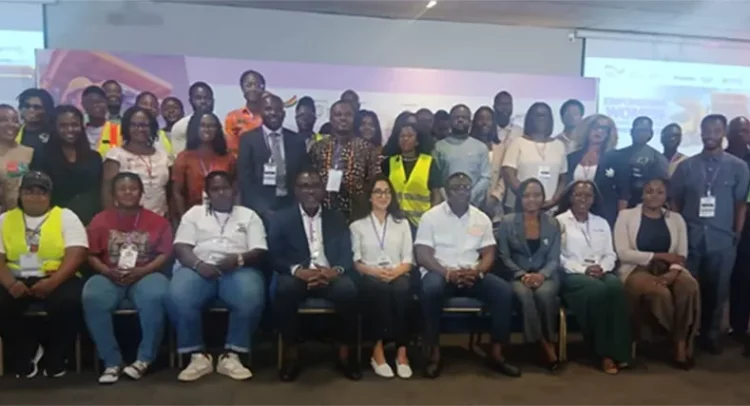
Group photograph of women in the mining industry, officials and attendees
The Empowering Women in Mining Transport Project has been launched to improve women’s employability in the county’s heavy transport sector, with a particular focus on the mining industry.
The project, themed, “Accelerating Women’s Participation in Ghana’s Heavy Transport and Mining Industries through Skills Development and Strategic Partnerships”, is supported by the German Federal Ministry for Economic Cooperation and Development (BMZ) and implemented by the Deutsche Gesellschaft für Internationale Zusammenarbeit (GIZ) through the develoPPP programme, in partnership with Scania West Africa, Reach for Change, and Women in Mining.
Speaking at the launch, GIZ Country Director, Sandra Retzer, said the project builds on GIZ’s experience and takes that commitment into another important area of Ghana’s economy.
She said Ghana’s mining and transport industries depend on skilled workers, reliable logistics, operational discipline, and high standards of safety, yet women remain underrepresented in many technical and operational roles, including professional heavy-duty truck driving.
“Too often, the barriers are not simply a lack of ability. They include limited access to specialised training, stereotypes about traditionally male occupations, inadequate professional networks, concerns about workplace conditions, and a lack of clear pathways from training into employment. Addressing these barriers is important not only for women themselves, but for employers as well,” she said.
She called on mining and transport employers to open doors for qualified graduates, noting that these opportunities will transform the participants’ careers and families, and inspire more women to enter the sector.
“Most importantly, the project aims for the trained women to secure decent jobs as truck drivers. That employment target is central to our approach. Our experience has consistently reinforced the importance of connecting training providers with industry, ensuring that training reflects actual labor market needs, and involving employers in the transition from learning to work,” she said.
Managing Director of Scania West Africa, François Lecha, said the programme would provide professional driver training, road safety, defensive driving, vehicle familiarization, operational excellence, confidence building, and career readiness, addressing skills shortages and proving that excellence in transport and mining knows no gender.
Building on past training successes in Ghana, Côte d’Ivoire, and Burkina Faso, where female participants demonstrated outstanding commitment and went on to become role models, he said the new initiative invests in people, diversity, and the future of the sector.
“As we move forward, our ambition is not only to train women, but to help create long-term career opportunities and demonstrate that excellence in transport and mining knows no gender,” he added.
The Director of Analysis, Research and Finance at the Ghana Chamber of Mines, Christopher Opoku Nyarko, speaking on behalf of the Chief Executive Officer, said while Ghana’s mining industry employs millions of people, women make up less than 10% of the formal workforce and less than two per cent of heavy truck drivers and heavy equipment operators.
He said the gap exists not because women cannot drive or operate machines, but because they have not been given adequate training, opportunities, and confidence.
BY Janet Odei Amponsah