
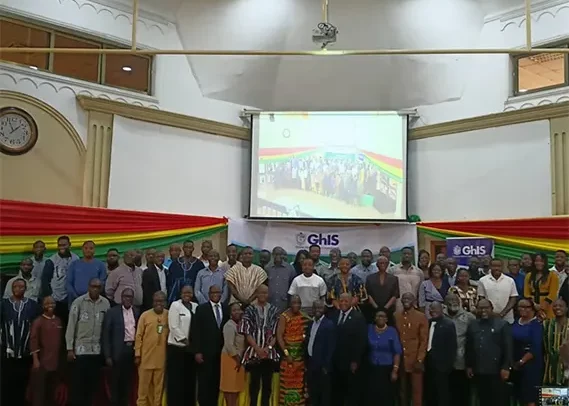
Yusif Sulemana (M) in a group photograph with GhIS members
The Deputy Minister for Lands and Natural Resources, Yusif Sulemana, has stated that persistent challenges facing the country in acquiring land and compensation payments continues to threaten public infrastructure projects as well as exposing the state to mounting financial liabilities.
The minister, who made this known at workshop organised by the Ghana Institution of Surveyors (GhIS) on Wednesday, said the delays in compensation payments, multiple ownership claims, inadequate land documentation and failure to follow due processes in compulsory land acquisition continue to affect project implementation and public confidence in land administration.
“Challenges associated with land acquisition and compensation payments have resulted in prolonged disputes, multiple claims, unpaid claims, litigation and significant financial liabilities for the state,” he said.
He noted that although land remains a critical resource for infrastructure development, housing, agriculture and industrialisation, government’s ability to undertake public projects must be balanced with the protection of the rights and interests of affected landowners and communities.
The minister mentioned that compulsory acquisition should comply with the 1992 Constitution and the Land Act, 2020 (Act 1036), which provide for fair, prompt and adequate compensation to persons whose properties are acquired in the public interest.
He explained that the law also requires the publication of an Executive Instrument in the Gazette, specifying the nature, extent and location of the land to be acquired and the purpose of the acquisition, where the Lands Commission is mandated to act on behalf of the state in the compulsory acquisition process.
He, however, stated that some public projects proceed without the necessary Executive Instrument, resulting in inadequate investigations into land ownership, competing claims, litigation and judgment debts.
Mr. Sulemana said there were instances where more land than necessary had been acquired, while incomplete cadastral information, overlapping ownership claims and inadequate documentation continued to complicate the identification of legitimate owners and compensation assessment.
He said the situation sometimes becomes even more difficult in flood-prone areas where the physical boundaries of properties and ownership interests may be difficult to establish, particularly where affected individuals did not submit claims before flooding occurred.
He, therefore, called for stronger collaboration among the Ministry, the Lands Commission, project-implementing agencies, traditional authorities, affected communities and professional institutions, particularly the Ghana Institution of Surveyors, while urging government agencies to undertake proper land investigations at the planning stage of public projects, including cadastral surveys, ownership verification, identification of affected interests and early consultations with landowners and communities.
President of the Ghana Institution of Surveyors, Emmanuel Kofi Cobbold, for his part, said stakeholders involved in land acquisition and development projects have been urged to streamline compensation processes and ensure timely payment to landowners, to prevent disputes, litigation and delays.
He explained that, compensation should be assessed and paid before contractors move to project sites. He, however, disclosed that the need to start projects sometimes results in contractors ignoring established procedures, leaving landowners waiting for compensation even after their properties have been taken over, leading to rejected compensation offers, litigation and delays.
Mr. Cobbold emphasised that land acquisition and compensation should be treated as part of project planning rather than an issue to be addressed after construction has started, stressing that stakeholders should work towards testing proposed solutions since the major challenge was not the absence of legislation but weaknesses in its implementation.
By Ebenezer K. Amponsah