
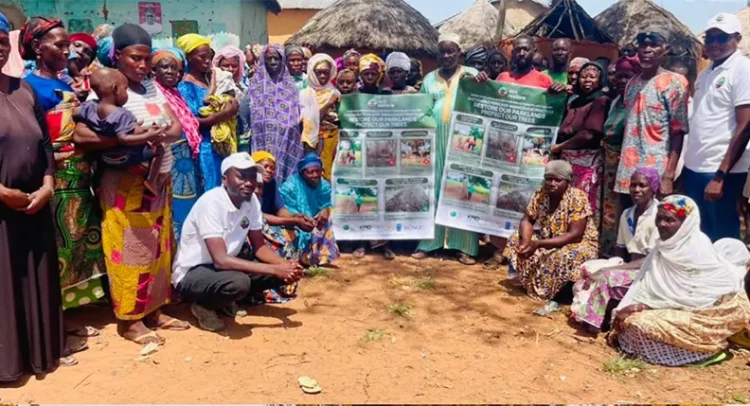
Eco Restore, a climate-smart Ghanaian organisation working to restore indigenous tree cover, promote zero burning, improve food security and strengthen livelihoods across Northern Ghana, has trained farmers in 27 communities across the North East and Savannah regions to protect their trees and manage their parklands sustainably.
The training, held from October 20 to 31, 2026, formed part of the organisation’s annual community parkland protection initiative.
The training aimed to equip farmers with practical knowledge and skills to prevent bushfires, protect young trees and improve parkland management, ahead of the harmattan season.
The initiative covered 17 communities under the Ghana Shea Landscape Emission Reductions Project (GSLERP), six communities under the Fuji Oil Ghana (FOG) Project and four communities under the Golden Forest (GF) Project.
A total of 1,448 farmers participated in the training across the three projects, comprising 750 men and 698 women and under the Golden Forest Project, 167 farmers participated, including 83 men and 84 women.
The FOG Project recorded 384 participants, comprising 216 men and 168 women, while GSLERP accounted for 897 participants, including 451 men and 446 women.
The beneficiary communities included Sawaba, Boayini, Zanguga, Singbini, Sagadugu, Binduri, Nabulugu, Takorayiri, Boamasa, Kparigu, Shelinvoya, Sooba, Tiya, Fung, Fio East and Fio West in the West Mamprusi Municipality.
The other communities were Naamiyala, Bongbini, Gbangu, Bunboazio, Tangbini and Tinpela in the East Mamprusi Municipality; and Daboya, Tari No. 1, Tari No. 2, Singa and Anyanto in the North Gonja District.
Abubakari Amadu Baaba, Assistant Operations Manager for Tree Growing at Eco Restore, who led the training, said the exercise formed part of the organisation’s continued efforts to equip farmers with practical knowledge on protecting their trees, particularly during the dry season.
“As we approach the dry harmattan season, the risk of bushfires increases. We are therefore educating farmers on how to create firebreaks, clear dry vegetation around trees and guard young trees against livestock. These measures will go a long way towards reducing damage and improving tree survival,” he said.
Adam Osman Wumbei, Assistant General Manager at Eco Restore, highlighted the organisation’s commitment to promoting zero burning and sustainable land management.
“Apart from educating farmers on the importance of growing indigenous trees, we also advocate against harmful practices such as bush burning and unsustainable land management to protect the resources on which farming communities depend,” he added.
Suweiba Yakubu, Media and Markets Officer at Eco Restore, urged farmers to use insecticides responsibly, noting that excessive use is affecting insect pollinators, and edible caterpillars, all of which are critical to biodiversity and food security.
Station Officer Akolbila Joseph of the Ghana National Fire Service in the North East Region, commended Eco Restore and its partners for organising the training ahead of the dry season.
He urged farmers to avoid careless burning and establish firebreaks to prevent fires from spreading across farms and communities.
At Boayini, Inusah Sule, a tree farmer and chairman of the community’s firefighting group, shared how residents use whistles to alert one another whenever a fire breaks out.
For Karim Wumpua, a tree farmer from Gbangu, indigenous trees provide benefits beyond their environmental value, adding that she uses nutritious baobab leaves to prepare soup for her household, and expressed concern about bush burning and its effects on trees, farms and soil fertility.
GSLERP is funded by the Green Climate Fund, with matching private-sector investments, and is jointly implemented by the Forestry Commission of Ghana and the Global Shea Alliance, with technical assistance from the United Nations Development Programme (UNDP Ghana).
FROM Eric Kombat, Tamale