
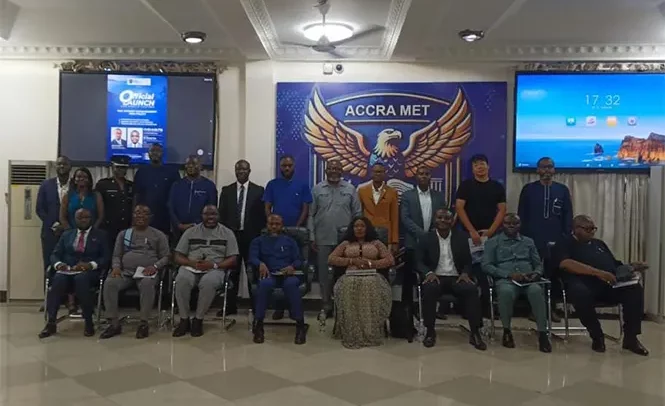
Officials in a group photograph at the launch of the MSc Energy Management and Policy programme
The Vice Chancellor of Accra Metropolitan University, Professor Goski Alabi, has officially launched the institution’s new MSc Energy Management and Policy programme alongside a public lecture on sustainable energy solutions.
The initiative aims to equip professionals with the policy, managerial, and technological expertise needed to drive Ghana’s transition towards energy security.
The launch coincided with a public lecture held under the theme, “Powering Ghana’s Future: Energy Security, Sustainable Transition, and Policy Innovation.”
Professor Goski Alabi, who is also a Professor of Quality Management, Strategic Leadership, and Corporate Governance at the University of Professional Studies, Accra (UPSA), emphasised that the postgraduate programme combines policy, management, innovation, and sustainability to equip graduates to respond effectively to Ghana’s evolving energy needs and support the country’s transition toward a resilient energy future.
”To support this mission, we have established an industry-oriented, employment-linked skills development training centre. The facility will train professionals in electrical services, renewable energy, electric mobility including e-vehicles, e-motors, and e-engines and emerging energy-efficiency technologies, as well as practical digital skills such as drone piloting,” she disclosed.
In addition, she stated that the university has also secured accreditation from the Commission for Technical and Vocational Education and Training (CTVET) to train electricians under the TVET voucher programme.
Set to roll out in October in collaboration with the Electricity Company of Ghana (ECG), she mentioned that the initiative will focus on equipping electricians with skills in advanced digital devices and appliances designed to enhance national energy sustainability.
Director of Power at the Ministry of Energy and Green Transition, Sulemana Abubakari, delivering a speech at the launch on behalf of the Minister of Energy and Green Transition, noted that Ghana requires institutions capable of solving domestic problems, stressing that few issues are as consequential to national industrialisation, job creation, and investment as a reliable energy system.
“The country faces a dual imperative: securing dependable, affordable, and clean energy to power the economy today while simultaneously building a sustainable, just, and orderly energy infrastructure for tomorrow,” he stated.
To achieve this, he emphasised that the government under President John Dramani Mahama is pursuing comprehensive energy sector reforms, and these strategic interventions focus on improving power sector efficiency, reducing distribution losses, strengthening transmission reliability, expanding renewable energy, securing domestic gas supplies, and establishing robust frameworks for private sector investment, ensuring energy acts as an enabler of growth across manufacturing, mining, agriculture, and enterprise.
”Beyond physical infrastructure such as power plants and solar farms, human capital remains the cornerstone of energy security, therefore, the new MSc programme is strategically important because Ghana’s energy transition must also be a transition in knowledge, skills, and leadership,” he noted.
He urged the students not to pursue the degree merely for an academic qualification, but as a mandate to help solve critical national challenges surrounding grid stability, clean cooking access, project finance, and green job creation.
”The programme’s success will be measured by the practical solutions its graduates bring to boardrooms, regulatory bodies, and national policy, converting higher education into vital infrastructure for national development,” he stressed.
The MSc in Energy Management and Policy programme aims to equip leaders to drive Ghana’s energy transition through three core pillars: shaping evidence-based policy, driving technical and financial innovation, and energising local communities with practical, reliable energy solutions.
By Janet Odei Amponsah