
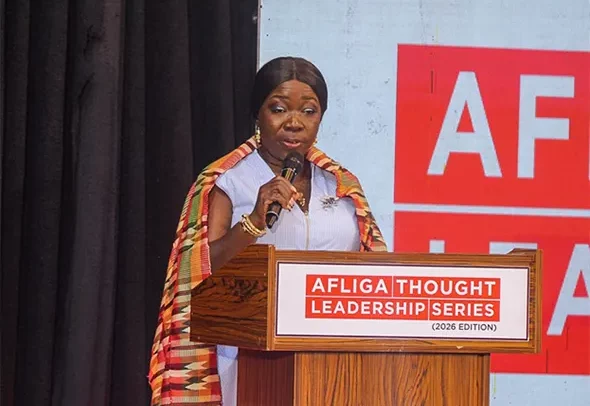
Elizabeth Ofosu-Adjare
Merchandise trade in Africa reached approximately $1.5 trillion in 2025, while intra-African trade stood at only $203.8 billion, highlighting a huge untapped commercial opportunity on the continent.
Minister for Trade, Agribusiness and Industry, Elizabeth Ofosu-Adjare, disclosed this at the 2026 Africa Thought Leadership Series held under the theme, “Reimagining African SMEs Financing, Trade, Governance and Economic Development Goals in the Next Decade: Any Hope for Agenda 2063?”
She said the theme was not merely about optimism but a call to action to determine what needed to be done differently over the next decade to make Agenda 2063 deliver tangible improvements in the lives of Africans.
According to her, Africa had never lacked vision, but the challenge had been translating that vision into opportunities that businesses and citizens could feel.
She noted that micro, small and medium-sized enterprises (MSMEs) remained central to Africa’s economy, supporting livelihoods in agriculture, processing, manufacturing, trade and services, but continued to struggle to access finance to scale up their operations.
“A processor may already have buyers but still be unable to acquire machinery to increase output, while a manufacturer may secure a sizable order but lack working capital to fulfil it,” she said.
Mrs. Ofosu-Adjare said the Ghana Enterprises Agency and the Ghana Export Promotion Authority continued to support enterprise development and market access, while steps were underway to establish the Women’s Development Bank to support women and youth entrepreneurs.
She said Ghana, as host of the African Continental Free Trade Area (AfCFTA) Secretariat, had established a coordinating office and was among the leaders in implementing the agreement.
However, she stressed that the value of AfCFTA would ultimately be judged by what businesses could actually achieve under the agreement.
“For a Ghanaian enterprise seeking consumers elsewhere in Africa, the existence of a trade agreement is merely the beginning. The product must meet required standards, transport costs must be competitive, border processes must work efficiently, and payments must be dependable,” she said.
The Minister also questioned Africa’s capacity to take advantage of the continental market if it continued to export raw materials with little processing.
“What will Africa sell into that market? You can have AfCFTA, trade duty-free, quota-free, but what do you have to sell? For many years, substantial quantities of our agricultural and natural resources have left the continent with limited processing,” she said.
She said the government was strengthening the link between agriculture and industry.
Through Executive Instrument 2025, she said, President John Dramani Mahama had realigned the Ministry to include Agribusiness to drive value addition.
She said the 50 Industrial Hubs Programme would link agriculture and local raw materials to production, while Cabinet had approved policies covering investment, value addition, automobiles, garments and textiles, and agribusiness.
Mrs. Ofosu-Adjare also cited the 24-Hour Economy and the Accelerated Export Development Programme as initiatives aimed at raising productivity, noting that improved macroeconomic stability and a more predictable cedi would support businesses.
On trade barriers, she identified non-tariff barriers as among the most critical obstacles to intra-African trade and called for stronger efforts to address them.
Executive Director, Africa Future Leaders Institute of Global Affairs (AFLIGA), Dr. Emmanuel Dei-Tumi underscored the urgent need to bridge the financing gap for women and youth-led Small and Medium Enterprises (SMEs) across the continent. Highlighting Africa’s demographic shift, where young people make up over 35% of the population in countries like Ghana and one in four global citizens will be African by 2050, he argued that, current financial structures fail to support emerging entrepreneurs who lack traditional collateral.
Beyond immediate funding mechanisms, Dr. Dei-Tumi emphasised that, early capital formation through grassroots initiatives like high school investment clubs can instill lifelong savings habits and financial literacy. He also stressed the importance of aligning National Youth Authorities across Africa to share proven solutions and scale regional trade opportunities.
”This agenda feeds into a broader vision to empower 1,000 young, high-impact professionals in every African nation by 2050, ensuring the continent’s expanding youth demographic becomes the primary driver of sustainable economic transformation,” he said.
The Executive Secretary of the African Capacity Building Foundation, Mr Mamadou Biteye, said Africa needed to move from agenda to agency by building integrated production systems, strengthening state capability and becoming creators rather than consumers of technology.
Liberia’s Foreign Minister, Sara Beysolow Nyanti, said SMEs were “the economy itself” and called for fairer access to capital, the elimination of border friction, stronger institutions and greater inclusion of women and young people.
By Janet Odei Amponsah