
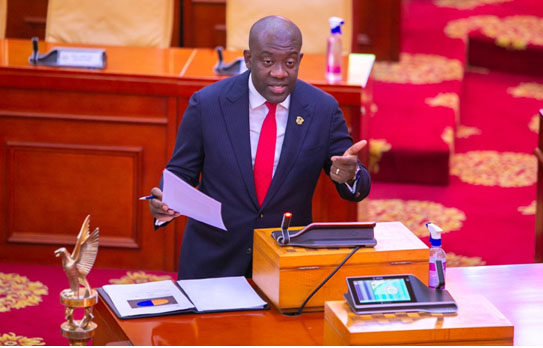
Kojo Oppong Nkrumah
The Ranking Member of Parliament’s Economy and Development Committee, Kojo Oppong Nkrumah, has criticised the government’s foreign exchange management strategy, indicating that the cedi has depreciated by approximately 10.5 percent against the US dollar by early November 2026, despite the Bank of Ghana selling about US$9.2 billion into the foreign exchange market within eight months.
He said the development exposed the weaknesses in the government’s approach to currency stabilisation and raised questions about the sustainability of the interventions used to support the local currency.
Speaking at the Minority’s press conference ahead of the presentation of the 2027 Budget Statement and Economic Policy, Mr. Oppong Nkrumah stated that the cedi’s performance in 2026 had contradicted the government’s celebration of its strong appreciation in 2025.
He said the government had relied heavily on foreign exchange injections to support the cedi, warning that such an approach could not provide a lasting solution without strengthening the country’s capacity to generate foreign exchange.
Mr. Nrkumah, who is also the NPP MP for Ofoase-Ayirebi, cited market reports indicating that the Bank of Ghana sold approximately US$9.2 billion into the foreign exchange market between January and August 2026, including US$2.01 billion in June alone.
Despite the interventions, he indicated that the cedi had lost 9.5 percent of its value against the dollar by September and nearly 10.5 percent by early November.
He further asserted that by May 2026, the cedi had become the worst-performing currency in West Africa.
The opposition MP also expressed concern about the country’s declining international reserves, which he said fell from approximately US$14.5 billion in February to US$11.1 billion in August.
This represented a reduction of more than US$3 billion in six months, according to the Ranking Member.
Mr. Nrkumah said the continued use of foreign exchange reserves to support the cedi raised questions about the country’s ability to sustain the interventions without weakening its external buffers.
He also referred to the Bank of Ghana’s reported loss of approximately GH¢8.3 billion from exchange rate movements on its foreign assets and gold in 2025.
Beyond the foreign exchange market, Kojo linked the government’s reliance on small-scale gold purchases to concerns about illegal mining and environmental destruction.
It said the GoldBod reported generating US$1.87 billion from small-scale gold trading in September alone, arguing that the growing demand for gold to obtain foreign exchange required an effective system for tracing the origin of the metal.
He expressed concern that a guaranteed state buyer paying cash for small-scale gold could create incentives for illegal mining activities if the source of the gold was not properly monitored.
The Ofoase-Ayirebi MP questioned whether the government’s efforts to obtain foreign exchange through gold purchases were contributing to pressure on the country’s water bodies and the worsening galamsey problem.
He also argued that local industries had suffered from the effects of currency movements.
He said manufacturers faced increased competition from imports when the cedi appreciated, while the subsequent depreciation increased the cost of imported machinery and production materials.
The MP therefore demanded that the government publish monthly figures showing the amount of foreign exchange sold into the market, the sources of those dollars and the proportion obtained through small-scale gold purchases.
He also, on behalf of the Minority, wants GoldBod to provide a timetable for implementing a comprehensive gold traceability system.
He said the 2027 Budget must outline a sustainable strategy for stabilising the cedi rather than rely on repeated foreign exchange interventions.
By Ernest Kofi Adu, Parliament House