
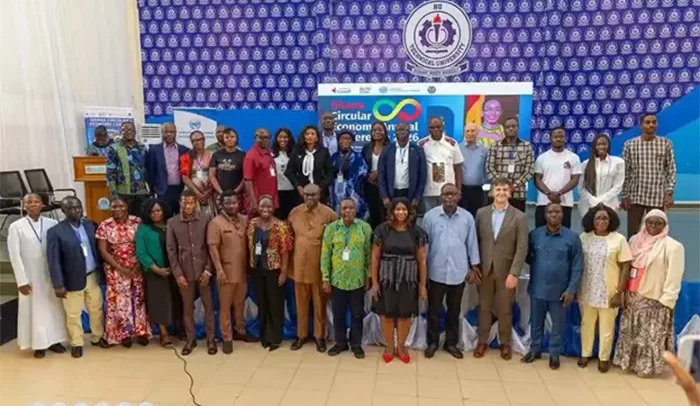
Stakeholders at the conference
The government has identified the circular economy as a major driver of job creation, local production and sustainable economic growth, urging stakeholders to transform waste into economic value.
Dr. Peter Justice Dery, Director of Environment at the Ministry of Environment, Science, Technology and Innovation (MESTI), speaking on behalf of the sector Minister, Dr. Zanetor Agyeman-Rawlings, said the circular economy was not merely a slogan but a strategic pathway to resetting the economy and advancing the government’s 24-hour economy agenda.
He made the statement at the 2026 Ghana Circular Economy Conference held at the Ho Technical University (HTU) in the Volta Region.
Dr. Agyeman-Rawlings said deliberate decisions on how resources were produced, consumed and managed could help Ghana reduce waste while unlocking new economic opportunities, particularly for young people.
She noted that materials discarded prematurely represented lost economic value, while polluted water bodies posed serious threats to livelihoods, public health and the environment.
The Minister said the circular economy could boost local production, create jobs, improve industrial competitiveness and promote cleaner communities. She therefore called for the production of durable goods, stronger repair and reuse systems, and innovative approaches to recovering value from materials that would otherwise end up as waste.
She said the government had begun putting in place the legal and institutional framework to facilitate the transition, citing the Environmental Protection Act, 2025 (Act 1124), which mandates the Environmental Protection Agency (EPA) to promote circular economy approaches and extended producer responsibility.
Dr Agyeman-Rawlings further disclosed that the planned phase-out of certain single-use plastics would require businesses to develop suitable alternatives, creating opportunities for local manufacturers and entrepreneurs.
She said the Ghana Circular Economy Centre would be instrumental in moving the country away from the traditional linear model of extracting, using and discarding resources towards a system that keeps materials and their value in productive use for as long as possible.
The Centre, she said, would bring together policy, research, businesses, finance, technical expertise, skills and markets through a Centre of Excellence, technical assistance and capacity building, access to finance, networking and knowledge exchange.
The Founder and Executive Director of Environment 360, Cordie Aziz-Nash, said Ghana must deliberately invest in green skills, practical training and local enterprises to fully harness the employment and economic opportunities offered by the circular economy.
Ms Aziz-Nash, the Guest Speaker, said the circular economy required skills in areas including product design, machine operation, material management and entrepreneurship, stressing that collection alone could not create a functional circular economy.
She urged stakeholders to connect materials, skills, finance and markets, while ensuring that workers engaged in collecting, sorting, repairing and processing materials had the requisite skills, safety, income and job stability.
Speaking on behalf of the Volta Regional Minister, James Gunu, Deputy Director at the Volta Regional Coordinating Council, Yannick Noah Agboado, reaffirmed the region’s commitment to supporting the Circular Economy Project.
The Vice Chancellor of HTU, Prof Ben Q. Honyenuga, said the university was committed to supporting the Ghana Circular Economy Centre and the annual conference as part of efforts to promote sustainable development.
By Daniel K. Orlando, Ho