

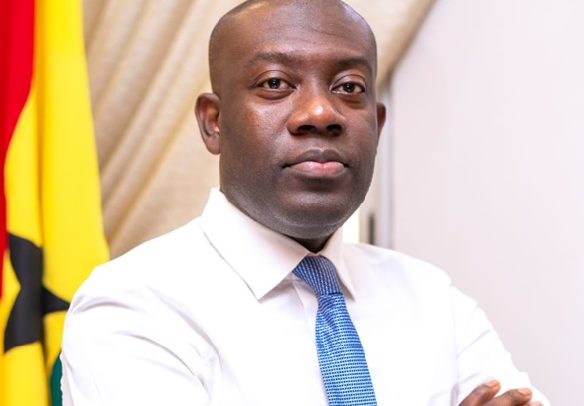
Kojo Oppong Nkrumah
The Member of Parliament (MP) for Ofoase-Ayirebi, Kojo Oppong Nkrumah, has raised serious concerns over what he described as a growing disconnect between the government’s portrayal of Ghana’s economic performance and the lived realities of ordinary citizens.
Taking his turn on the debate of the President’s recent State of the Nation message, Mr. Oppong Nkrumah questioned the reliability of official data, arguing that government statistics on economic growth, inflation, and job creation fail to reflect the daily experiences of Ghanaians.
“As we listen to you paint a very glossy picture of the state of the nation, we observe that there is a wide gap between your state of the nation and the lived experience of millions of our compatriots,” he stated, noting that government officials rely on data generated in Accra, disconnected from conditions on the ground.
He cited agriculture as a critical sector where official statistics fail to align with reality. Rice farmers, he said, struggle to find buyers for their produce due to limited liquidity, while maize, cashew, yam, and cocoa farmers face similar challenges, with some even considering selling cocoa farms to illegal miners for financial survival.
“A nation in which the state of its farmers is worsening cannot claim to have an improved state of the nation,” he argued.
The MP also highlighted the plight of manufacturers and service providers, emphasising rising utility bills, escalating costs of locally produced raw materials, and shrinking business margins.
Hairdressers, welders, cold store operators, and coders, he said, are all grappling with economic pressures that contradict government claims of improvement.
Mr. Oppong Nkrumah was particularly critical of the Majority MPs’ focus on inflation rates, which he described as misleading.
He pointed out that while official figures suggest a decline, from 3.8% to 3.3%, citizens continue to experience a high cost of living, limited purchasing power, and scarcity of cash in circulation, which hinder business and economic activity.
He further disputed claims of massive job creation, stating that the alleged one million new jobs for youth in nine months are not evident in communities, and young Ghanaians continue to struggle for employment opportunities.
The New Patriotic Party (NPP) MP called for investigations into the $214 million loss in gold transactions and the circumstances under which half of the country’s gold reserves were sold, noting that these critical issues remain unexamined in Parliament.
Criticising government policies as largely rebranding exercises, he pointed to initiatives such as the transformation of Precious Minerals Marketing Company (PMMC) to the Ghana Gold Board and the domestic gold purchase programme now labeled Ghana Accelerated National Reserve Accumulation Policy, suggesting that such measures do not address underlying economic challenges.
He also raised concerns about rising domestic borrowing, which he said could exacerbate fiscal pressures.
Mr. Oppong Nkrumah concluded that the true measure of the country’s economic health is found in the lived experiences of citizens, not in statistics that may appear favourable on paper.
By Ernest Kofi Adu, Parliament House