
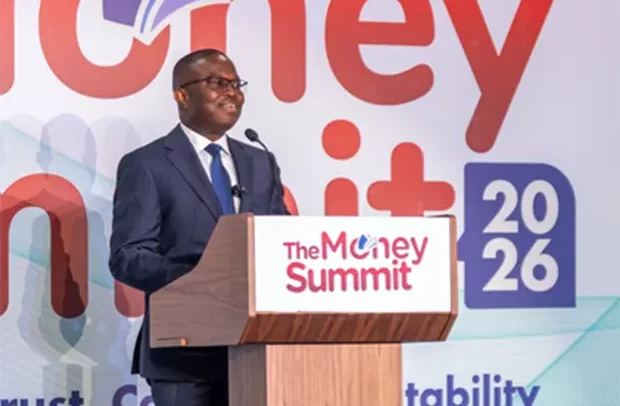
Atta Yeboah Gyan
The Deputy Managing Director for Operations and Support Functions at Fidelity Bank Ghana, Atta Yeboah Gyan, has called for a deliberate and coordinated effort to channel more capital into productive sectors of the economy, arguing that the nation’s recent macroeconomic gains will only yield lasting prosperity if businesses in key sectors gain better access to credit.
Speaking at the Business and Financial Times’ Money Summit 2026 on the theme, “Building Trust, Capital and Stability for Ghana’s Economic Future,” Mr. Gyan said significant structural barriers continue to prevent many enterprises from accessing formal financing despite their contribution to economic growth.
He acknowledged the nation’s economic recovery, noting that real Gross Domestic Product (GDP) growth reached six percent in the fourth quarter of 2025, inflation declined from 23.8 percent in December 2024 to 5.4 percent by the end of 2025, while gross international reserves stood at US$13.9 billion in April 2026, representing 5.5 months of import cover.
However, he pointed to persistent challenges within the financial sector, particularly the disconnect between credit allocation and productive sectors such as agriculture.
According to him, although agriculture played a key role in expanding the nation’s trade surplus by 26 percent year-on-year to US$5.28 billion in April 2026, the sector recorded a non-performing loan ratio of 54.7 per cent as of February 2026.
“There is a fundamental mismatch between where our export strength comes from and where our credit is going,” he said.
Mr. Gyan identified a growing trust deficit as a major challenge facing the financial sector.
He explained that existing credit assessment models often fail to capture the realities of Ghana’s economy, leaving many economically active individuals outside the formal financial system.
He also cited the lingering effects of the banking sector clean-up and the Domestic Debt Exchange Programme, which weakened public confidence in financial institutions.
He highlighted several Fidelity Bank initiatives aimed at supporting underserved sectors.
Through the Mastercard Foundation’s BRIDGE-in-Agriculture programme, the bank disbursed GH¢66.9 million last year, supporting more than 22,000 smallholder farmers and creating or sustaining over 24,000 jobs.
The bank also supported climate-smart businesses and young entrepreneurs through its GreenTech Innovation Challenge and Orange Corners Innovation Fund.
Mr. Gyan urged stakeholders to establish risk-sharing mechanisms for agricultural lending, adopt alternative credit assessment systems using digital and mobile money data, and expand patient capital through grants and concessionary financing.
“Ghana has done something genuinely hard. It came back from the edge. Now the question is what we build with the stability we have earned,” he said.