
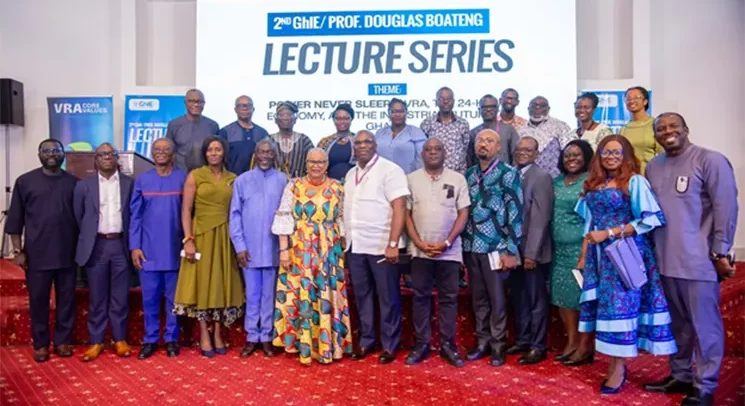
Participants in a group photo
The Chief Executive (CEO) of the Volta River Authority (VRA), Ing. Edward E. Obeng-Kenzo, has called on engineers to take on a more strategic leadership role in driving the country’s industrial transformation, stressing that the success of the Government’s 24-Hour Economy agenda will depend largely on engineering innovation, resilient infrastructure and long-term planning.
According to him, engineers will be at the centre of efforts to build the factories, power systems, transportation networks and digital infrastructure needed to transform Ghana into a globally competitive industrial economy.
Speaking at the second Ghana Institution of Engineering (GhIE)-Professor Douglas Boateng Lecture Series in Accra, Ing. Obeng-Kenzo described the 24-Hour Economy initiative as both a challenge and an opportunity for the engineering profession.
“The engineers gathered here today will play a defining role in its success. We have both the responsibility and the privilege of building the foundation upon which future generations will prosper,” he stated.
He urged the GhIE to position itself as the country’s leading engineering think tank by providing evidence-based policy recommendations, strengthening professional standards and promoting strategic leadership within the engineering community.
The VRA boss outlined several measures he believes are necessary to support the nation’s industrial ambitions.
These include championing infrastructure development to ensure reliable electricity supply, reducing technical losses in power systems through engineering solutions, influencing national energy policy and establishing a long-term engineering foresight agenda to guide infrastructure planning over the next two to five decades.
He also advocated stronger engineering ethics, improved contract management practices, continuous professional development and greater investment in specialised engineering skills to equip the workforce for emerging energy and infrastructure demands.
Ing. Obeng-Kenzo further challenged engineers to apply their expertise to solving pressing national problems, including the recurring flooding that affects Accra and several other parts of the country.
He urged the profession to support government efforts by developing innovative and sustainable engineering solutions capable of addressing such long-standing challenges.
The lecture series also featured remarks from Professor Douglas Boateng, founder of the initiative, who said the platform was created to celebrate excellence in Ghana’s engineering profession while promoting thought leadership on industrialisation and national development.
Professor Boateng stressed the need for engineers to adopt a long-term perspective in their work, arguing that sustainable industrial growth can only be achieved through planning that extends beyond political cycles.
He noted that engineering decisions made today would shape the country’s economic future for generations and therefore required a strategic and forward-looking approach.
The President-Elect of the Ghana Institution of Engineering, Ing. Sophia Tijani, said the annual lecture series was designed to bring together ideas, expertise and innovation to advance Ghana’s development agenda and strengthen collaboration across Africa.
She explained that this year’s theme was chosen to highlight the indispensable role of reliable electricity in achieving the Government’s 24-Hour Economy vision, describing the Volta River Authority as an appropriate partner for the national discussion.
“We cannot achieve a successful 24-hour economy without reliable power generation,” she said.
Ing. Tijani noted that the lecture series has become an important platform for engineers, policymakers and industry leaders to exchange ideas and explore practical solutions to the country’s infrastructure and industrialisation challenges.
The annual GhIE–Professor Douglas Boateng Lecture Series continues to serve as a forum for advancing engineering excellence and promoting dialogue on strategies that can support Ghana’s industrial growth and sustainable national development.
A Daily Guide report