
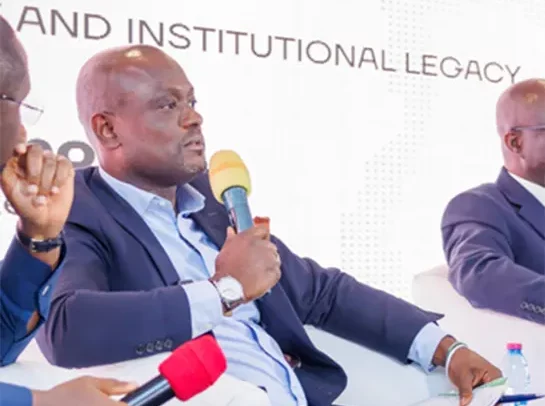
Aaron Ameyaw
Fidelity Bank Ghana has called for stronger stakeholder collaboration, harmonised trade systems and targeted institutional support to remove structural barriers limiting the growth of Ghanaian traders and entrepreneurs, particularly women.
The call was made by two senior executives of the bank at the Breaking Barriers to Trade conference, where they participated in sessions on trade modernisation and women-led enterprise development.
Director of Banking Operations, Aaron Ameyaw, speaking on “Reimagining Trade, Influence and Institutional Legacy,” identified poor data quality and fragmented customs systems as major obstacles to trade growth in Ghana and across the region.
He said although artificial intelligence (AI) offered significant opportunities to transform trade and commerce, its effectiveness depended on the quality of data available.
“In Ghana, data is a problem. These AI machine learners thrive on data. And so if your data is not correct, you have big issues,” he said.
Mr. Ameyaw called for greater harmonisation of customs regimes across neighbouring countries, noting that traders, particularly women importing goods from countries such as Togo and Nigeria, continued to face bureaucratic processes that increased costs and delayed transactions.
He welcomed the introduction of the Publican AI System in early 2026 to complement the Integrated Customs Management System at the nation’s ports, saying the technology had contributed to revenue growth of more than US$300 million.
He said Fidelity Bank was also leveraging technology internally, including robotic process automation for reconciliation processes, to improve efficiency and free employees to focus on higher-value tasks.
“It is important that we get the fundamentals right. Once we get it right, it creates opportunities,” he said.
Director of SME Banking, Alex Agyei-Amponsah, focused on the challenges confronting women-led businesses, noting that between 38 and 46 percent of businesses in the region were owned by women.
He said the major challenge was not a lack of ambition but the difficulty of balancing business growth with family and other responsibilities.
Mr. Agyei-Amponsah said Fidelity Bank was addressing the challenge through the Fidelity Young Entrepreneurs Fund, which targets young entrepreneurs and women, providing support from the idea stage through incubation to market readiness.
The programme provides financing at concessionary rates and support to help entrepreneurs meet regulatory and compliance requirements that could otherwise prevent them from accessing markets.
He also highlighted the bank’s group lending model, citing a woman involved in a yam export contract to Canada through the Federation of Associations of Ghana Exporters.
He said the group arrangement had enabled her to participate in the contract despite being unable to undertake it independently.
A Business Desk Report