
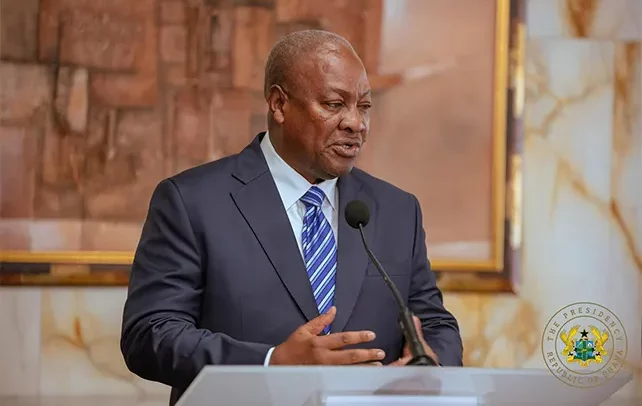
President John Mahama
The government has approved a GH¢350 million emergency package to provide relief to flood victims and finance long-term mitigation measures following the devastating floods that affected thousands of people across Greater Accra and other parts of the country.
The Minister for the Interior, Mohammed-Mubarak Muntaka, who announced the intervention in Parliament yesterday, said President John Dramani Mahama authorised the release of funds from the national contingency allocation after assessing the scale of the disaster.
According to the minister, GH¢200 million will be used to procure relief items for nearly 10,000 affected households nationwide, while GH¢150 million has been earmarked for flood mitigation projects in vulnerable coastal areas.
“The President instructed that from the contingency fund we should be able to access some money. A total amount of GH¢350 million is being targeted to help deal with the challenges,” Mr. Muntaka told Parliament.
He said the President personally undertook an aerial inspection of the flooded areas before directing that immediate financial support be released to assist victims and strengthen the country’s flood response.
Mr. Muntaka disclosed that 7,761 households, representing 38,802 people, had been displaced across 18 metropolitans, municipal and district assemblies in Greater Accra, while the floods claimed 12 lives and left seven people missing.
He said the government had activated the National Disaster Management Committee under the National Disaster Management Organisation Act to coordinate the emergency response, with ministers joining chief directors and heads of key emergency agencies to oversee operations.
The minister added that the government had deployed the Ghana Armed Forces’ 48 Engineers Regiment to undertake emergency drainage clearance and engineering works to speed up recovery while avoiding procurement delays.
He said the Ghana Meteorological Agency (GMA) had issued advance weather forecasts before the storm, prompting the Ministry of the Interior to advise residents, particularly in Accra, to remain indoors.
He believes the early warning significantly reduced casualties by limiting movement during the heaviest rainfall.
According to Mr. Muntaka, the rains brought 169.2 millimetres of precipitation in a single day, the fourth-highest daily rainfall since 1995, while June recorded 593.2 millimetres, the highest monthly rainfall ever recorded in Ghana.
Although he acknowledged that blocked drains and developments on waterways contributed to the flooding, the minister maintained that the exceptional volume of rainfall would have posed serious challenges even under improved drainage conditions.