
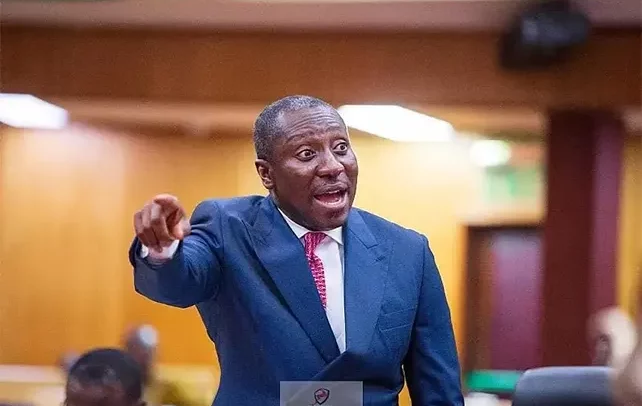
Alexander Afenyo-Markin
The Minority Leader, Alexander Afenyo-Markin, has raised concerns over the growing number of international narcotics seizures involving consignments linked to Ghana, warning that the country risks becoming a safe haven for international drug trafficking networks.
He said repeated interceptions of substantial quantities of cocaine and other illicit drugs in foreign jurisdictions had exposed possible weaknesses in the country’s port security, cargo inspection procedures, customs controls and intelligence coordination.
Speaking during Parliament’s leadership engagement with the media at the opening of the Third Meeting of the Second Session of the Ninth Parliament in Accra yesterday, Mr. Afenyo-Markin demanded answers from the government on how drug traffickers continued to exploit Ghana’s ports and trading routes.
He cited the interception of approximately 3.9 tonnes of cocaine by French authorities at the Port of Dunkirk on September 7, 2026. The consignment, concealed in a shipment of plastic waste reportedly originating from Ghana, was estimated to be worth €225 million.
He said the incident was not isolated, pointing to previous major seizures in Amsterdam, Antwerp and Sydney, as well as interceptions within Ghana, including at the Tema Harbour enclave and Pedu Junction in Cape Coast.
He recalled that Dutch authorities intercepted almost 4,500 kilogrammes of cocaine concealed in timber from a Ghanaian company in June 2025, describing it as the largest cocaine seizure in Amsterdam’s port history.
In November 2025, Belgian authorities also seized 2,829 kilogrammes of cocaine concealed in cassava flour shipped from Tema.
In April 2026, Australian authorities detected suspicious cargo in two containers from Ghana, purportedly carrying charcoal. Investigations subsequently led to the detection of 320 kilogrammes of methamphetamine in September 2026.
Mr. Afenyo-Markin further cited a recent report from Lebanon involving 46.7 kilogrammes of cocaine allegedly carried by a passenger arriving from Accra.
“Timber, cassava flour, charcoal, plastic waste, now passenger luggage, different concealment, different destinations, but all repeated links to Ghana,” he said.
He questioned how the consignments were processed and cleared, what happened during inspection and scanning, and whether the relevant agencies had the intelligence and resources required to detect such shipments.
“Why does it take a seizure abroad to trigger explanation at home?” he asked.
The Minority Leader said the government owed Ghanaians more than announcements of investigations, insisting that it must provide honest explanations, take corrective action and demonstrate results.
He acknowledged the efforts of Ghanaian officers involved in intercepting narcotics and pursuing traffickers, but said their work could not excuse possible failures in supervision, institutional coordination and political leadership.
He questioned why officials found culpable of negligence remained in office, arguing that administrative accountability should not be suspended because criminal investigations or prosecutions were ongoing.
“An arrest is not a conviction. Equally, a pending criminal trial does not suspend administrative accountability,” he stated.
He stressed that President John Dramani Mahama had a responsibility to secure Ghana’s borders and answer for “the government’s poor performance in protecting them.”
Although he conceded that drug smuggling had occurred under previous administrations, he said that history could not be used to excuse current failures.
Mr. Afenyo-Markin warned that the repeated seizures could damage Ghana’s international reputation and undermine confidence in the country’s export controls and legitimate commercial activities.
He said exporters, shipping companies, airlines and passengers could face increased scrutiny because of the activities of drug traffickers, resulting in additional inspections, shipment delays, storage charges, missed connections and higher compliance costs.
He cautioned that legitimate businesses and innocent travellers risked paying the commercial and reputational price for criminal activities from which traffickers stood to benefit.
Beyond the economic implications, he warned that international drug trafficking could also encourage the development of local distribution networks, with serious consequences for public health, security and the country’s young people.
He said the proliferation of illicit drugs threatened the future of the youth, destroyed families, undermined productivity and placed additional pressure on healthcare and social welfare systems.
Minority Review Motion
He disclosed that the Minority had, through its First Deputy Whip, Habib Iddrisu, filed a review of Speaker Alban Bagbin’s September 29, 2026 ruling on a private member’s motion seeking a parliamentary inquiry into the seizures.
He maintained that criminal prosecutions should not be used to shield public institutions from parliamentary scrutiny, explaining that Parliament had a separate constitutional responsibility to examine institutional failures and recommend corrective measures.
He said the Minority was not seeking to interfere with criminal investigations or determine the guilt or innocence of accused persons but wanted answers about the security and regulatory weaknesses that might have allowed substantial quantities of narcotics to pass through Ghana-linked commercial channels.
“Our ports must serve legitimate commerce. Our borders must command respect. Our young people deserve protection. Our country’s reputation deserves defending,” he said.
He added that the Minority would continue to pursue the matter, demand accountability and insist on concrete measures to prevent international drug trafficking networks from exploiting Ghana’s ports and trading routes.
By Ernest Kofi Adu, Parliament House