
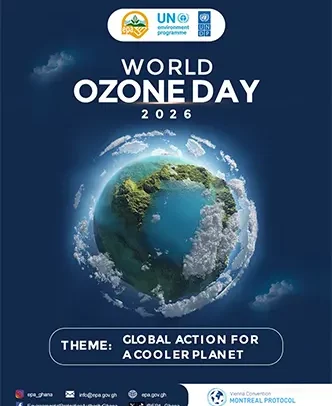
As Ghana joinsthe global community, to observe World Ozone Day under the theme “Global Actionfor a Cooler Planet,” in partnership with UNDP, it is marking the occasion witha review of the country’s achievements in protecting the ozone layer and the climate,and a renewed call on all Ghanaians to support the nation’s continuing transition to safer, climate-friendly cooling.
Observes on 16 September 2026, Ghana reflects on nearly four decades of ozone preservation in accordance with the Montreal Protocol and ten years of accelerating climate-friendly cooling under the Kigali Amendment.
Ghana’s Key Successes under the Montreal Protocol and Kigali Amendment include ratifyingthe Vienna Convention and the Montreal Protocol in 1989 and has since ratifiedall its amendments, including the Kigali Amendment, formalising the country’s commitment to phase down hydrofluorocarbons (HFCs) alongside its long-standing phaseout of ozone-depleting substances (ODS). Also, Ghanasuc
successfully eliminated the consumption of chlorofluorocarbons (CFCs) by 2010,well ahead of many peer countries, protecting both the ozone layer and public health from excess ultraviolet radiation.
Under Stage II of its HCFC Phase-out Management Plan (HPMP), implemented with UNDP and UNEP as cooperating agencies and financed by the Multilateral Fund, Ghana continues to reduce hydro chlorofluorocarbon consumption in line with Montreal Protocol targets, supporting technicians and industry to move away from HCFC-22 in air-conditioning and refrigeration.
Committed, under its Nationally Determined Contribution (NDC), to achieving 70 percent penetrations of very-low-GWP refrigerants in air conditioners by 2030. This will eventually lead to the adoption of more energy-efficient cooling, lower household energy costs and greater access to modern, climate-friendly technologies.
The EPA has secured the passage of the Refrigeration and Air Conditioning Technicians Certification Regulations (L.I. 2503, 2025), which standardise training and certification for RAC technicians nationwide ensuring they can install,service, decommission and handle refrigerants and alternative natural and flammable refrigerants safely and responsibly, and prevent leaks.
Management of ODS and HFC regulation: Passageof L.I. 2505 (2025) on the Management of ODS, Halocarbons, Halocarbon Alternatives and their Products which is the updated regulatory framework governing refrigerant imports and use to support the Kigali Amendment to theMontreal Protocol, targeting the phase down of Hydrofluorocarbons (HFCs)alongside traditional Ozone Depleting Substances.
The country further adopted the National Cooling Plan and the RAC Roadmap (2022) as anational roadmap to transform the refrigeration and air-conditioning sector toward high-efficiency, low Global Warming Potential (GWP) technologies. Roll-out of a national voluntary “green label” scheme by the EPA’s National Ozone Unit, enabling consumers to identify air conditioners and refrigeration equipment using natural, low-global-warming-potential refrigerants such as propane (R290) and isobutane (R600a).
Ongoing training and engagement of customs officials, enforcement officers, and supervisory agencies to strengthen border controls, prevent illegal trade of substandard refrigerants and inefficient cooling appliances into the Ghanaian market.
Establishment of a Refrigerant Recovery and Recycling Centres of Excellence to support safe refrigerant management and reduce emissions from servicing and disposal of cooling equipment. The National Committee on Ozone Depleting Substances (NACODS) continues to advise on ODS and HFC policy, while Ghana’s National Cooling Plan and an import licensing and quota system for controlled substances help track and manage the country’s ODS and HFC consumption baseline. : Working with international and private partners, Gha na has developed a national roadmap Forman aging ODS banks to manage the end of life of refrigerants, coolingappliance, foams under the Environmental Protection, Act 1124 (2025)
and-reducing emissions from the refrigeration and air-conditioning sector.
The EPA calls onevery Ghanaian household, businesses, technicians and institutions to play their part: Choose ozone- and climate-friendly appliances by checking labelsfor natural or low-GWP refrigerants and good energy ratings before buying fridges, freezers and air conditioners. Engage only trained and soon to be certified RAC technicians for installation, servicing, repair and disposal of cooling equipment, to prevent illegal refrigerant venting and ensure safe handling.
Maintain and service equipment properly and regularly to reduce refrigerant leaks, lower electricity bills and extend the life of appliances.
Dispose of old refrigerators, freezers and airconditioners responsibly through approved recovery and recycling schemes rather than dumping them.
Avoid patronising unregistered importers of refrigerants and second-hand cooling equipment, which may carry banned or high-GWP substances.
Report suspected illegal trade in banned refrigerants or the importation of substandard cooling equipment to the EPA. •Raise awareness in schools, workplaces and communities about the ozone layer,climate change and Ghana’s obligations under the Montreal Protocol and Kigali Amendment.