
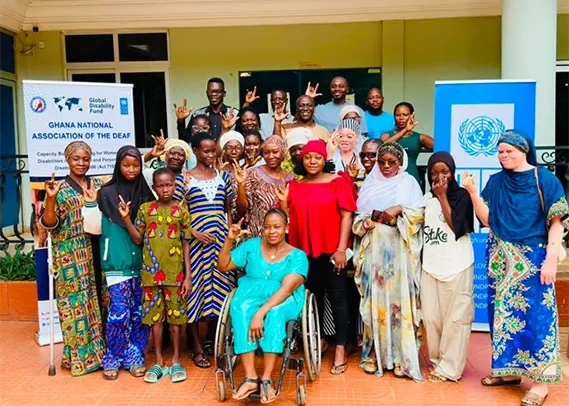
Officials of GNAD, UNDP with participants in Tamale
The Ghana National Association of the Deaf, in partnership with the Organisations of Persons with Disabilities in Ghana and with support from UNDP and the Global Disability Fund, has held a two-day capacity building training for women and girls with disabilities on advocacy and leadership in Tamale.
The programme focused on leadership, governance, data-driven advocacy, and knowledge of rights under the UN Convention on the Rights of Persons with Disabilities (CRPD) and Ghana’s Persons with Disabilities Act, Act 715. The goal is to equip women and girls with disabilities to influence policy, engage decision-makers, and take up leadership roles.
Ghana ratified the UNCRPD in 2008 and passed Act 715 the same year. Article 6(1) of the Convention specifically recognises that women and girls with disabilities face multiple forms of discrimination and calls on states to ensure their full and equal enjoyment of all human rights.
Addressing participants, Executive Secretary of the Ghana National Association of the Deaf, Juventus Duorinaah, Esq., said women with disabilities continue to face exclusion. “Women with disabilities are less likely to take up leadership positions, and more likely to face discrimination and limited participation in governance and decision-making,” he said.
He added that within OPDs, deaf women, blind women, women with albinism, women with mental health conditions and women with cerebral palsy face even greater barriers due to limited access to information, low awareness of their rights, and weak participation in organisational governance.
“Beyond social and institutional barriers, we recognise a capacity gap. Limited capacity prevents them from participating effectively in decision-making and advocating for their rights,” Mr. Duorinaah stated. He explained that the training was held solely for women and girls to create a safe space where they can learn at their own pace and contribute freely, given the intersection of disability, gender and cultural factors.
He urged participants to build networks and use the knowledge gained to advocate for their rights and the rights of others.
Speaking on behalf of UNDP, Paul Akuamoah Boateng commended GNAD and partners for advancing disability inclusion. “Inclusive development is not just policy. It is about ensuring every individual, regardless of disability, has equal opportunities to participate and thrive,” he said.
He noted that women and girls with disabilities still face stigma, limited access to education, jobs, justice and leadership, especially in underserved regions. He said UNDP’s focus is to move beyond awareness to practical skills that drive change, and stressed that Ghana cannot achieve the SDGs without women and girls with disabilities as leaders and partners.
Participant representative, Madam Adam Ayishetu of GAPA, thanked the organisers.
“We did not know we had the right to request documents from MMDAs. Now we know the laws and how to use them to demand accessibility and accountability,” she said.
FROM Eric Kombat, Tamale